By Matteo Martignago, cinematographer and founder of Artistic Hive · Updated July 2026
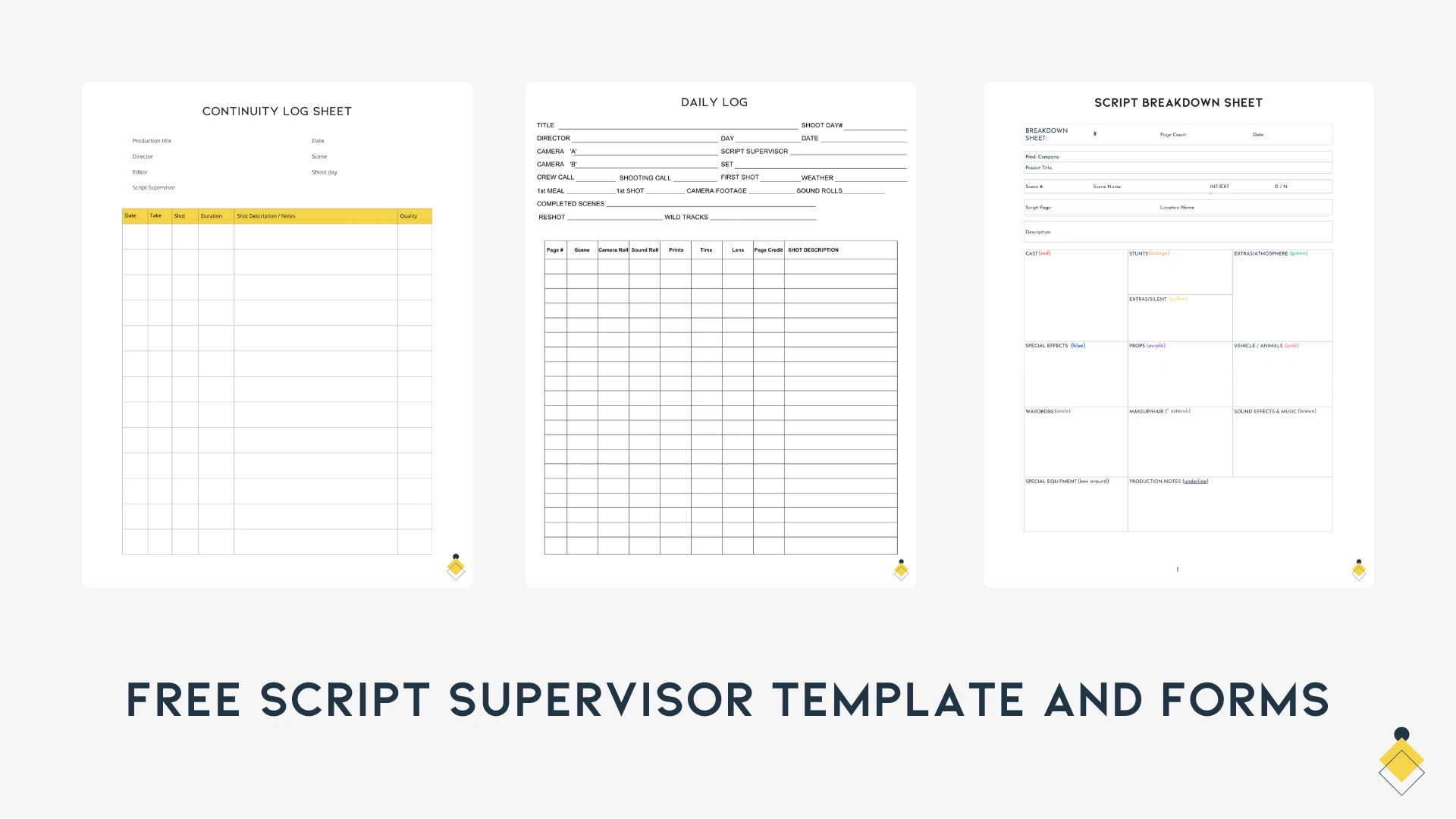
You can download three free script supervisor templates below: a daily log, a continuity log sheet, and a script breakdown sheet, all as printable PDFs. A good script supervisor template keeps a shoot consistent from take to take, and each of these is laid out the way a working set really uses it. Below the downloads, here’s what every form tracks, when to reach for it, and how it keeps a shoot from falling apart in the edit.
Free Script Supervisor Templates to Download (PDF)
| Template | What it tracks | When you use it |
|---|---|---|
| Daily Log | Scene, slate, take, timings, page & setup counts for the day’s work | Rolling, all day, on every take |
| Continuity Log | Wardrobe, props, hand positions, eyelines, set dressing, shot to shot | Whenever a detail could change between takes or scenes |
| Script Breakdown | Cast, props, costumes, makeup, and effects each scene needs | In prep, before the scene shoots |
All three open in Google Drive, where you can print them or save a copy. They’re free to use on your own productions.
What Is a Script Supervisor Template?
A script supervisor template is a structured form for recording continuity on a film set: the running record of what was shot, how, and what state every prop, costume, and performer was in. It keeps a production consistent from take to take and scene to scene, so a coffee cup that was half full in one shot doesn’t come back full in the next. The script supervisor fills it in live during the day, then hands it to the editor, who relies on it to cut the film together without continuity errors slipping through.
On the sets I’ve shot, the script supervisor sitting by the monitor is the crew’s continuity safety net. When I change a camera setup or a lens between takes, their notes are what tell the editor why an eyeline or a background shifts. The catches that stay with you are the small ones: a watch that jumps from the left wrist to the right between angles, a glass that refills itself, a jacket that’s zipped in the wide and open in the close. By the time it reaches the edit it’s unfixable, so the note made on set is the only thing standing between a clean cut and a reshoot.
The Three Forms, and How a Set Uses Them
Script Supervisor Daily Log Template
The daily log is the day’s running record: every scene, slate, and take, with timings, page counts, and setup counts. It’s what the production office reads each night to know how far the shoot got and whether it’s on schedule. If Scene 12 runs to twelve takes or a setup has to be reset, that gets logged here too, so everyone knows exactly where the day landed against the plan.

Continuity Log Sheet Template
The continuity log tracks the details that have to match shot to shot: wardrobe, props, set dressing, hand positions, and eyelines. It’s the form that saves you when scenes are filmed out of order. Say an actor starts a dining scene with a fork in their left hand. Note it here, and when the coverage shoots the next day, the fork is still in the left hand and the audience never notices a thing.

Script Breakdown Template
The script breakdown works ahead of the shoot rather than during it. Scene by scene, it lists everything a scene needs (cast, props, wardrobe, makeup, and special effects) so each department knows what to prep before the camera rolls. Break down Scene 8 and you’ll itemize the vintage clock, the red scarf, and the smudged makeup an actor wears after a fight, and nobody discovers a missing prop at the worst possible moment.

Digital vs. Paper Forms: Which Should You Use?
Both still earn their place on set. Digital forms win on speed and sharing; paper wins on reliability and simplicity. Here’s how they compare.
| Digital forms | Paper forms | |
|---|---|---|
| Best for | Larger productions, remote crew, fast turnarounds | Small shoots, tough conditions, no-tech backup |
| Strengths | Real-time sharing, searchable notes, fewer counting errors, quick export to the editor | No battery or software to fail, instant visual overview, familiar and fast |
| Trade-offs | Depends on devices, apps, and charge | Slower to share, harder to search later |
If you go digital, a few apps are built for exactly this work on an iPad: Scriptation for marking up and sharing scripts, Shot Lister for scene scheduling and progress, and MovieSlate for digital slating and shot logging in one place. Many supervisors also run ScriptE to auto-calculate timings and counts.
Plenty of supervisors run a hybrid setup: a tablet for the working record and printed sheets as a backup when a battery dies or a location has no power. The templates above print cleanly, so they cover the paper side of that plan.
What Makes a Template Work on Set
The best forms disappear into the workflow. A supervisor is watching a take, not hunting for a box to write in, so a good template is quick to scan and has an obvious place for every note: scene and take up top, continuity details where the eye lands first. It should cover the essentials without drowning you in fields you’ll never fill: timings and counts on the daily log, physical details on the continuity sheet, department needs on the breakdown. Anything more and it slows the very person it’s meant to help.
That clarity pays off downstream. The director and editor read these notes to understand why a shot was framed a certain way and how scenes connect, and clean records are what let an editor cut confidently weeks after the day was shot.
Which Template Should You Start With?
If you’re new to the role, start with the daily log; it’s the backbone of the job and the one you’ll use every hour of every shoot day. Add the continuity log once you’re comfortable, since that’s where the small, film-saving details live. Bring in the script breakdown during prep on your next project. Download all three above, run them on a short shoot, and adjust the fields to fit how you work; the best template is the one you’ll keep up with when the day gets busy.
Script Supervisor Template FAQ
Are these script supervisor templates free?
Yes. The daily log, continuity log, and script breakdown above are free to download and use on your own productions. Each opens as a PDF in Google Drive that you can print or save.
What format are the templates in?
They’re print-ready PDFs. Download and print them for on-set use, or drop the printed sheets into a binder as a paper backup alongside whatever app you run.
Is there an editable Google Sheets or Excel version?
The templates above are print-ready PDFs for now. If you want to fill them in on screen, the layouts are simple enough to rebuild in Google Sheets or Excel in a few minutes using the screenshots as a guide, then print or share from there.
What does a script supervisor track?
Continuity, above all. That means what was shot in each take, the timings and counts for the day, and every physical detail that has to match across shots, from wardrobe and props to hand positions, eyelines, and set dressing. It all goes into a report the director and editor use in post.
What’s in a script supervisor report?
A day’s report pulls together the daily log and continuity notes: scenes and takes shot, timings, page and setup counts, any discrepancies spotted, and where the day landed against the schedule. It’s the document the editor leans on to assemble the cut cleanly.
Do script supervisors use a stopwatch?
Many do. Timing each take tells the production how long scenes run and helps flag pacing issues early, which matters on anything that needs precise comedic or dramatic timing. Most continuity apps now time takes automatically, but a stopwatch still does the job.