Updated November 2026. The quick answer: a good camera cleaning kit has an air blower, a lens pen or soft brush, microfiber cloths and a cleaning fluid that’s safe for coated lenses; add sensor swabs only if you’re comfortable cleaning your own sensor. The Altura Photo Camera Lens Cleaning Kit covers the lens basics for about $20, the UES 21-in-1 Camera Cleaning Kit adds sensor swabs and a hard case, and the LensPen DSLR Pro Kit is the liquid-free kit to keep in your bag.
Our picks at a glance
- Best lens cleaning kit: Altura Photo Camera Lens Cleaning Kit
- Best kit with sensor swabs: UES 21-in-1 Camera Cleaning Kit
- Best for your camera bag: LensPen DSLR Pro Kit
- Best air blower: JJC Dust-Free Air Blower
What’s in a camera cleaning kit? The essential list
Most kits mix the same handful of tools. Here’s what each one is for, in the order you’d use them:
| Tool | What it’s for | Good to know |
|---|---|---|
| Air blower | Blows loose dust and grit off the glass before anything touches it | Always start here: wiping grit across a lens can scratch it |
| Soft brush | Sweeps away dust the blower leaves behind | Keep it dry and clean, and don’t use it on the sensor |
| Lens pen | A brush on one end and a carbon tip on the other that lifts fingerprints and grease | Good for quick fixes in the field; the tip wears with use |
| Microfiber cloth | Wipes smudges off lenses, filters and screens | Keep it in its pouch and wash it regularly |
| Lens cleaning fluid | Breaks down oil and stubborn marks | Put a drop or two on the cloth or tissue, not straight on the lens |
| Lens tissue | Single-use paper for wet cleaning | Use each sheet once |
| Sensor swabs and sensor fluid | Remove smears from the sensor that a blower can’t shift | Match the swab to your sensor: 16mm for APS-C, 24mm for full frame |
| Case | Keeps everything clean and together | A hard case protects swabs and fluid in a camera bag |
Leave out canned air. Canon’s camera manuals warn against using canned air or pressurized gas on the sensor, because the force can damage it and the propellant can freeze on its surface, and they recommend a plain hand blower instead (Canon’s sensor cleaning guide). Skip household glass cleaners too: many contain ammonia, which is why lens fluids are sold as ammonia-free and safe for coated glass.
The best camera lens cleaning kits in 2026
All four are sold on Amazon; prices were checked in November 2026.
Altura Photo Camera Lens Cleaning Kit

Altura’s kit has everything you need for lenses and filters in one box: an air blower, a lens pen, a brush, an alcohol- and ammonia-free cleaning spray, three MagicFiber microfiber cloths and 50 sheets of lens tissue.
Altura’s suggested routine is simple: the blower for loose dust, the lens pen for fingerprints, then a little spray on a cloth for a streak-free finish. It works with any camera or lens brand.
Key specs: air blower · lens pen · brush · alcohol- and ammonia-free lens cleaner spray · 3 MagicFiber cloths · 50 lens tissues · about $20 on Amazon
Best for: most photographers who want one inexpensive kit for lenses, filters and screens.
UES 21-in-1 Camera Cleaning Kit
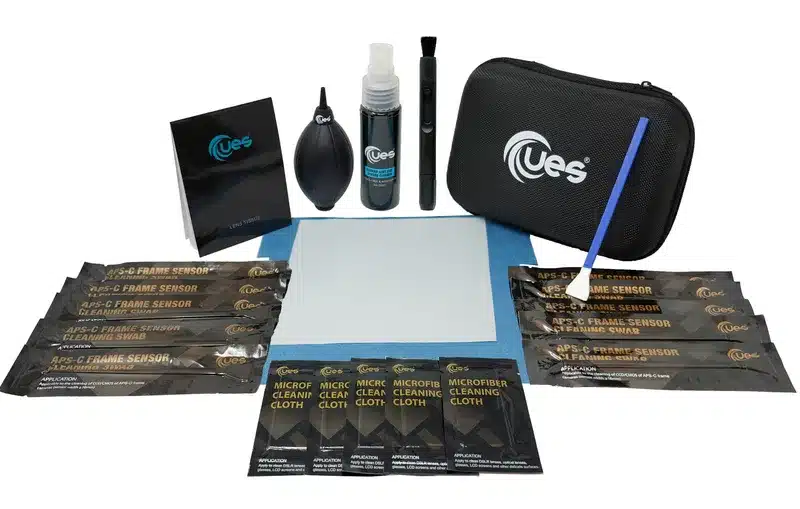
UES’s 21-in-1 kit (model DKL-16) adds sensor cleaning to the lens basics. It comes with ten 16mm APS-C sensor swabs, each vacuum-sealed and made in a Class-100 cleanroom, plus an alcohol- and ammonia-free cleaner for lenses and sensors.
You also get an air blower, a lens pen, microfiber cloths and 50 sheets of lens tissue, all in a water-repellent hard case. Shooting full frame? Get the full-frame version (DKL-24) instead, which comes with 24mm swabs.
Key specs: 10 APS-C sensor swabs (16mm) · lens and sensor cleaner · air blower · lens pen · microfiber cloths · 50 lens tissues · hard EVA case · about $30 on Amazon
Best for: photographers who want to clean their own sensor as well as their lenses.
LensPen DSLR Pro Kit
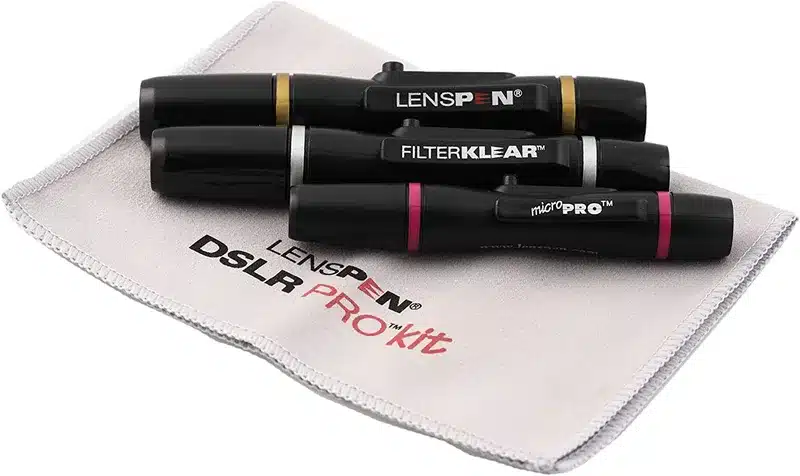
LensPen’s kit is three pens in a microfiber pouch: the original LensPen with a concave tip that matches the curve of a lens, a FilterKlear with a flat tip for filters, and a small MicroPro for viewfinders and other small optics.
Each pen has a retractable brush for dust and a carbon cleaning tip for fingerprints, so there’s no liquid to carry or spill, and the pouch doubles as a cleaning cloth.
Key specs: LensPen, FilterKlear and MicroPro · retractable brushes · carbon cleaning tips · microfiber pouch that doubles as a cloth · about $29 on Amazon
Best for: keeping in your camera bag for quick cleans on a shoot. It has no blower, so pair it with one.
JJC Dust-Free Air Blower

A blower is the one tool you’ll use every time, and JJC’s has a filter on its air intake that stops dust and grit larger than 21 microns from being sucked in and blown back onto your lens.
One-way valves at the intake and outlet keep the airflow clean, and a soft silicone tip protects your gear if you bump it. The Giottos Rocket Air Blaster is the classic alternative, a large blower that stands upright on your desk.
Key specs: dust filter at the intake (blocks particles over 21 microns) · one-way air valves · silicone tip · 3 spare filters · about $20 on Amazon
Best for: anyone building their own kit, and for blowing dust off the sensor the way Canon recommends.
How to clean a camera lens
- Blow off loose dust with the air blower, holding the lens facing down so the dust falls away.
- Brush away anything the blower left, gently, with a soft brush or the brush end of a lens pen.
- For fingerprints and smears, use the lens pen’s carbon tip, or put a drop or two of lens fluid on a microfiber cloth or lens tissue and wipe in a spiral from the center outward.
- Check the glass against a light and repeat if you need to, then clean the rear element and any filters the same way.
- Put the caps back on: a lens that stays capped needs cleaning far less often.
Sensor dust is different. Start with your camera’s automatic sensor cleaning, then a hand blower with the lens off. Use swabs only for marks the blower can’t move, and follow the kit’s instructions carefully; if you’d rather not touch the sensor, a camera service center can clean it for you.
Conclusion
For most photographers, the Altura Photo kit is the one to buy: it has the blower, lens pen, fluid and cloths you need for lenses and filters, for about $20. If you want to clean your own sensor, the UES 21-in-1 kit adds swabs in the right size and a hard case, and the LensPen DSLR Pro Kit is the small, liquid-free kit to keep in your camera bag.
Whatever you buy, start with the blower every time, keep the fluid on the cloth rather than the lens, and leave canned air and household glass cleaners out of it.
Frequently asked questions
An air blower, a soft brush or lens pen, microfiber cloths, a lens cleaning fluid and lens tissue, usually in a case. Kits for sensor cleaning add sensor swabs (16mm for APS-C, 24mm for full frame) and a sensor cleaning fluid.
Start with an air blower to remove loose dust, then use a lens pen or a microfiber cloth with a drop or two of lens cleaning fluid for fingerprints and smears. Wipe in a spiral from the center outward.
Yes. A hand air blower such as the JJC Dust-Free Air Blower or the Giottos Rocket Air Blaster blows dust off without touching the glass, and an anti-static brush such as the Matin Anti-Static Control Brush sweeps away what’s left.
No. Household glass cleaners like Windex often contain ammonia, which isn’t meant for the coatings on camera lenses. Use a lens cleaning fluid sold as safe for coated lenses instead.
No. Use pre-moistened wipes made for optical glass, or lens tissue with lens cleaning fluid. Household wipes, paper towels and clothing can leave residue or scratch the coating.
Only when it needs it. Blow off dust whenever you see it, and wet-clean when fingerprints or smears show up in your photos or against the light. Keeping the caps on means you’ll clean far less often.
Not on the sensor or inside the camera. Canon’s manuals warn that canned air or pressurized gas can damage the sensor and that the propellant can freeze on it; use a hand blower instead.
Run your camera’s automatic sensor cleaning first, then use a hand blower with the lens removed. If marks remain, use sensor swabs in the right size for your sensor with sensor cleaning fluid, or have a camera service center do it.
As an Amazon Associate, Artistic Hive earns from qualifying purchases.