Updated November 2026. The quick answer: the best lens for real estate photography is a wide-angle zoom covering about 14–35mm on a full-frame camera or 10–18mm on APS-C, and f/4 is fast enough. Our picks are the Canon RF 14-35mm F4 L IS USM for Canon, the Sony FE PZ 16-35mm F4 G for Sony and the Nikon NIKKOR Z 14-30mm f/4 S for Nikon; on a budget, the Canon RF-S 10-18mm F4.5-6.3 IS STM costs under $300.
Our picks at a glance
- Best for Canon: Canon RF 14-35mm F4 L IS USM
- Best for Sony: Sony FE PZ 16-35mm F4 G
- Best for Nikon: Nikon NIKKOR Z 14-30mm f/4 S
- Best budget lens: Canon RF-S 10-18mm F4.5-6.3 IS STM
- Best for Sony APS-C and video: Sony E PZ 10-20mm F4 G
- Best for Fujifilm: Fujifilm XF10-24mm F4 R OIS WR
- Best for perfect verticals: Canon TS-E 24mm f/3.5L II
Compare them all in the table below.
As someone who’s spent a lot of time photographing real estate, I’ve learned firsthand just how much the right lens can make or break a shot. Wide, clean, and distortion-free images are key and not every lens delivers that straight out of the box.
Over the past few years, I’ve tested a wide range of lenses in real-world real estate shoots, from compact apartments to sprawling luxury homes. In this post, I’m breaking down the best lenses for real estate photography based on my experience—covering what works, what doesn’t, and which ones give you the most value for your money.
Let’s dive into the list.

How to choose a lens for real estate photography
- Focal length: on full frame, 16mm is wide enough for most rooms and 14mm helps in small bathrooms and bedrooms. Much wider than 14mm and furniture near the edges starts to look stretched. On APS-C, look for about 10mm at the wide end.
- Aperture: f/4 is enough. Interiors are usually shot on a tripod at around f/8 so the whole room is sharp; an f/2.8 lens mainly helps with handheld video in dark rooms.
- Straight lines: use a rectilinear wide-angle lens, not a fisheye, and keep the camera level so walls stay vertical. Lightroom’s lens profiles and Transform tools fix what’s left.
- Video: if you film walkthroughs, a power zoom or stabilization makes smoother clips.
- Mount: buy the lens made for your camera. Older DSLR lenses can be adapted, but a native mirrorless lens is lighter and focuses faster.
What Are The Best Lenses For Real Estate Photography?
Here is our ranked and reviewed list of the best lenses for real estate photography.
Canon RF 14-35mm F4 L IS USM
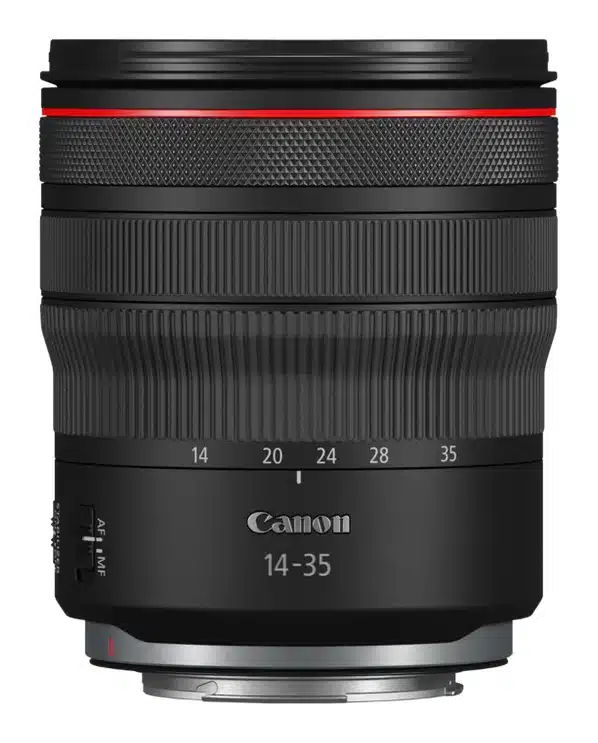
For Canon mirrorless shooters, this is the real estate lens to get. It starts at 14mm, wide enough to show a small bathroom or bedroom from the doorway, and its constant f/4 is all you need for interiors shot on a tripod.
It’s light for an L lens at about 540 g, takes standard 77mm filters, and has 5.5 stops of optical stabilization for handheld exteriors and walkthrough video. If you also shoot dark rooms or low-light video, the RF 15-35mm F2.8 L IS USM is the f/2.8 step up, at about $2,300.
Key specs: 14–35mm · constant f/4 · 5.5-stop optical stabilization · about 540 g · 77mm filters · focuses to 7.9 in at every focal length · about $1,350 on Amazon
Best for: Canon EOS R shooters, from the R8 to the R5 Mark II.
Sony FE PZ 16-35mm F4 G
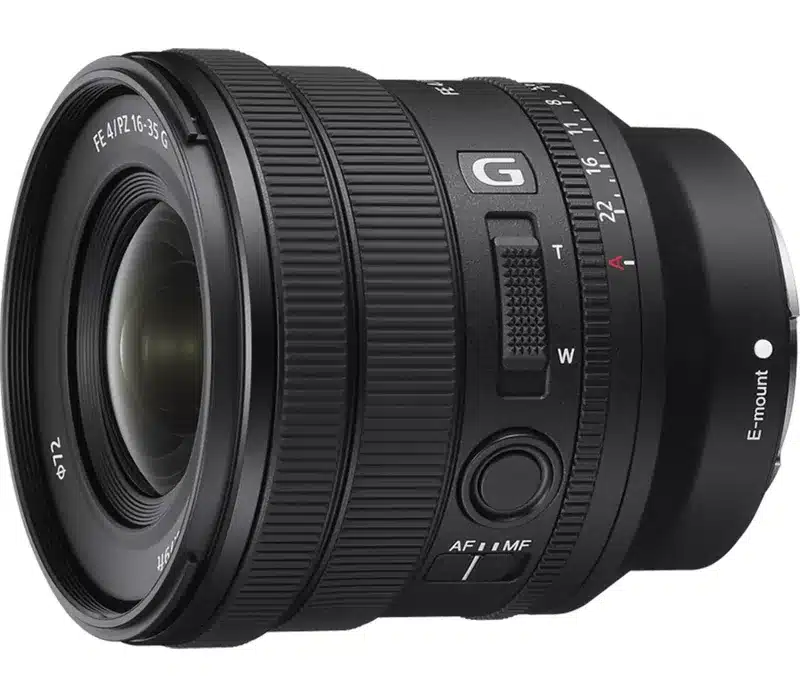
Sony’s 16-35mm G weighs just 353 g, so it’s easy to carry on a tripod or gimbal all day. Its power zoom gives smooth, steady zooms for property videos, and the constant f/4 keeps exposure the same as you zoom.
It takes 72mm filters and has separate zoom, focus and aperture rings. For an even wider view, the FE 12-24mm F4 G (about $2,300) goes to 12mm, but watch the edges for stretching.
Key specs: 16–35mm · constant f/4 · power zoom · 353 g · 72mm filters · about $1,200 on Amazon
Best for: Sony full-frame shooters who make listing videos as well as photos.
Nikon NIKKOR Z 14-30mm f/4 S
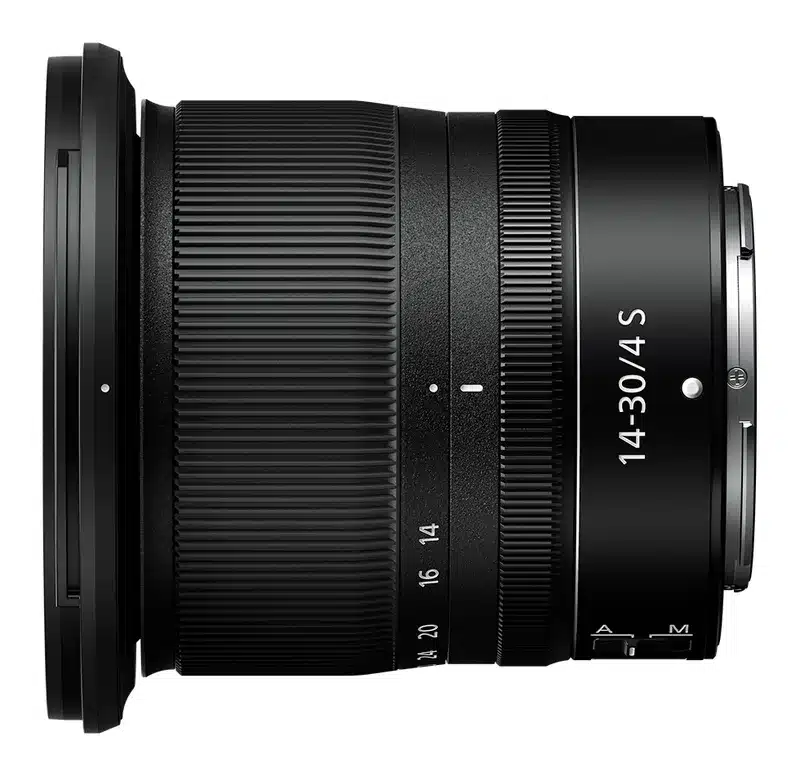
Unlike many ultra-wide zooms, Nikon’s Z 14-30mm f/4 S takes ordinary 82mm screw-on filters, so it’s easy to add a polarizer to cut reflections in windows and glossy floors.
It retracts to about 3.5 inches for travel, weighs 485 g, and its stepping motor focuses quietly for video.
Key specs: 14–30mm · constant f/4 · 82mm screw-on filters · retracts to 3.5 in · 485 g · about $1,100 on Amazon
Best for: Nikon Z shooters, and anyone who wants to use filters on an ultra-wide lens.
Canon RF-S 10-18mm F4.5-6.3 IS STM
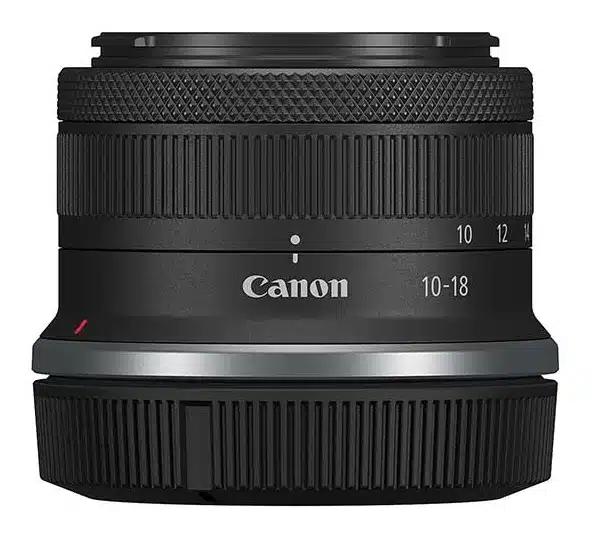
On an APS-C camera like the Canon EOS R50, R10 or R7, this 150 g lens gives a 16–29mm full-frame equivalent view, which covers most rooms. It’s the cheapest way into real estate photography with a Canon mirrorless camera.
The variable f/4.5–6.3 aperture is slower than the L lenses, but that matters little when you shoot interiors at f/8 on a tripod, and its 4-stop stabilization helps with handheld exteriors.
Key specs: 10–18mm (16–29mm equivalent) · f/4.5–6.3 · 4-stop optical stabilization · 150 g · about $280 on Amazon
Best for: beginners and agents shooting their own listings on a Canon APS-C camera.
Sony E PZ 10-20mm F4 G
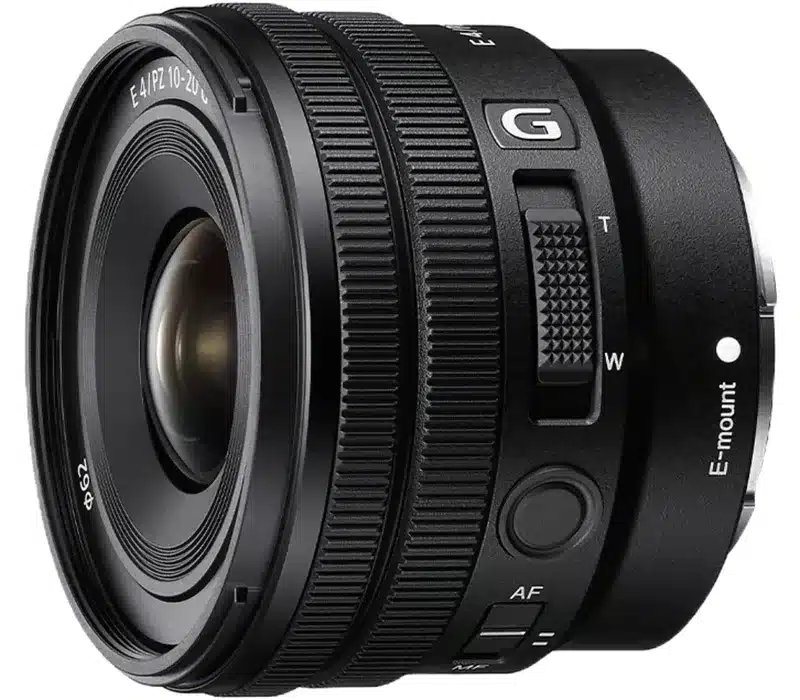
For Sony APS-C cameras such as the a6700 or ZV-E10 II, the E PZ 10-20mm gives a 15–30mm equivalent view with a constant f/4 aperture, in a lens that weighs only 178 g.
Its internal zoom and focus keep the lens the same length, which suits gimbals, and the power zoom makes smooth moves in walkthrough videos.
Key specs: 10–20mm (15–30mm equivalent) · constant f/4 · power zoom · internal zoom and focus · 178 g · 62mm filters · about $850 on Amazon
Best for: Sony APS-C shooters who film property tours.
Fujifilm XF10-24mm F4 R OIS WR
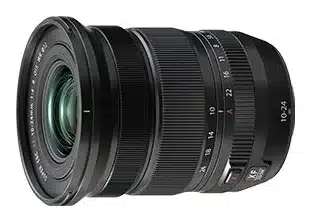
Fujifilm’s XF10-24mm covers 15–36mm in full-frame terms, so it goes from a wide room shot to a tighter detail without changing lenses. This weather-resistant version added an aperture ring with f-numbers and an “A” lock, and stabilization rated at up to 3.5 stops.
Key specs: 10–24mm (15–36mm equivalent) · constant f/4 · optical stabilization up to 3.5 stops · weather resistant · 385 g · 72mm filters · about $1,200 on Amazon
Best for: Fujifilm X shooters.
Canon TS-E 24mm f/3.5L II
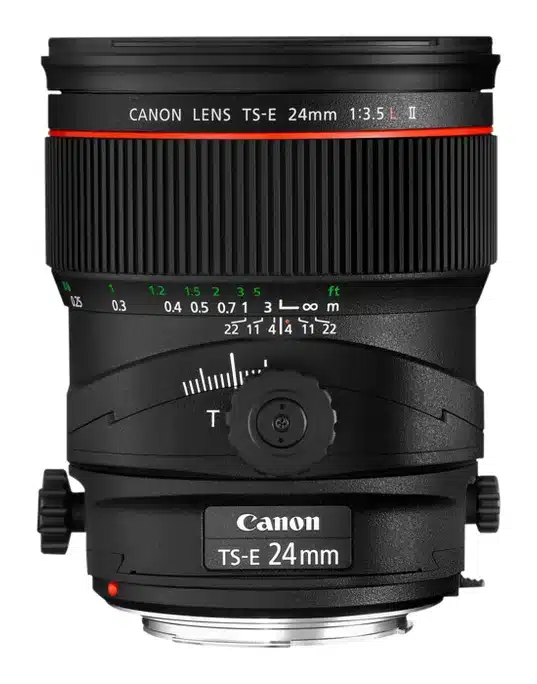
A tilt-shift lens keeps vertical lines straight in the camera: instead of tilting the camera up to fit in a tall room or a two-story facade, you shift the lens and the walls stay parallel. Canon’s TS-E 24mm is the classic choice, with ±12mm of shift and ±8.5° of tilt.
It’s manual focus and made for Canon’s EF mount, so on an EOS R camera you’ll need Canon’s EF-EOS R mount adapter (our EF vs RF guide explains the adapter options). At about $2,400 it’s a specialist tool; most photographers straighten verticals in Lightroom instead.
Key specs: 24mm · f/3.5 · ±12mm shift and ±8.5° tilt · manual focus · Canon EF mount · about $2,400 on Amazon
Best for: professionals shooting architecture and high-end listings who want perfect verticals without cropping.
Real estate lenses compared
| Lens | Mount | Full-frame equivalent | Aperture | Price on Amazon |
|---|---|---|---|---|
| Canon RF 14-35mm F4 L IS USM | Canon RF (full frame) | 14–35mm | f/4 | about $1,350 |
| Sony FE PZ 16-35mm F4 G | Sony E (full frame) | 16–35mm | f/4 | about $1,200 |
| Nikon Z 14-30mm f/4 S | Nikon Z (full frame) | 14–30mm | f/4 | about $1,100 |
| Canon RF-S 10-18mm IS STM | Canon RF (APS-C) | 16–29mm | f/4.5–6.3 | about $280 |
| Sony E PZ 10-20mm F4 G | Sony E (APS-C) | 15–30mm | f/4 | about $850 |
| Fujifilm XF10-24mm F4 R OIS WR | Fujifilm X (APS-C) | 15–36mm | f/4 | about $1,200 |
| Canon TS-E 24mm f/3.5L II | Canon EF (adapter on RF) | 24mm, ±12mm shift | f/3.5 | about $2,400 |
Conclusion
For most real estate photographers, a wide f/4 zoom made for your camera is the lens to buy: the Canon RF 14-35mm F4 L, the Sony FE PZ 16-35mm F4 G or the Nikon Z 14-30mm f/4 S. On an APS-C camera, the Canon RF-S 10-18mm is the budget way in, and the Sony E PZ 10-20mm and Fujifilm XF10-24mm cover the other systems. Add a tilt-shift lens only if you shoot architecture often enough to justify it.
The lens is only the first step: a tripod, a level camera and our tips to create stunning photos make the bigger difference in every room.
Do you have any questions about real estate photography? If so, please feel free to leave a comment below and I will do my best to answer them. Thanks for reading!
Frequently asked questions
Why is a wide-angle lens important for real estate photography?
A wide-angle lens allows you to capture more of the interior and exterior in a single shot, which is crucial for showcasing properties effectively. It helps to create a sense of space and depth.
How does distortion affect real estate photography?
Wide-angle lenses can bend straight lines near the edges and stretch objects in the corners, which makes rooms look unnatural. Use a rectilinear lens, keep the camera level, and apply the lens profile in Lightroom to straighten the rest.
What are the benefits of using a full-frame camera with a wide-angle lens?
Full-frame cameras usually capture a little more dynamic range, which helps in rooms with bright windows, and there are more lenses that go as wide as 14–16mm. An APS-C camera with a 10mm lens gets a similar view for less money.
Should I invest in a zoom lens for real estate photography?
For most real estate work, yes. A wide zoom like a 16-35mm lets you frame each room from the best spot without swapping lenses, and today’s wide zooms are sharp enough for listing photos. Wide primes and tilt-shift lenses are specialist tools.
What is the ideal focal length for real estate photography?
On full frame, about 16–24mm for most rooms, going to 14mm for small spaces; on APS-C, about 10–16mm. Use longer focal lengths for details and exteriors.
Do I need a tripod for real estate photography?
Yes. A tripod keeps the camera level so walls stay straight, lets you shoot at f/8 with slower shutter speeds, and lets you take several exposures to blend for rooms with bright windows.
How can I reduce distortion in my real estate photos?
Keep the camera level and at about chest height, avoid placing furniture right at the edges of a very wide frame, and use Lightroom’s lens profile and Transform tools to correct the rest. A tilt-shift lens keeps verticals straight in the camera.
Is 24mm wide enough for real estate photography?
On full frame, 24mm works for large rooms and exteriors but is too tight for most bedrooms and bathrooms. Most interiors need something wider, around 14–20mm.
Is f/4 fast enough for real estate photography?
Yes. Interiors are usually shot on a tripod at around f/8 so the whole room is sharp, so an f/4 lens loses nothing. An f/2.8 lens mainly helps for handheld video in dark rooms.
As an Amazon Associate, Artistic Hive earns from qualifying purchases.