Updated November 2026. The quick answer: today’s camera drones are rated for 10 to 20 km (6 to 12 miles) of live video transmission in the US, but US rules require you to keep your drone within visual line of sight, so in practice most flights stay within about a mile. Of the drones you can buy in the US, the DJI Air 3S has the best range and flight time for the money, the Autel EVO 2 Pro V3 is the alternative to DJI, and the DJI Mini 4K is the budget pick.
Our picks at a glance
- Best long-range drone overall: DJI Air 3S
- Best non-DJI drone: Autel EVO 2 Pro V3
- Best mini drone: DJI Mini 5 Pro
- Best budget drone: DJI Mini 4K
Compare range and flight time in the table below.
How far can a drone fly?
How far a drone can fly depends on two things: its video transmission range, which is how far it stays connected to your controller, and its battery, which has to bring it back. As a rough guide:
- Toy drones: up to about 100 m (300 ft), using Wi-Fi.
- Mini camera drones like the DJI Mini series: rated for 10 to 20 km of video transmission.
- Mid-size camera drones like the DJI Air series: rated for 20 km or more.
- FPV drones: a few kilometers in typical use; purpose-built long-range FPV drones go much further.
- Fixed-wing and commercial drones: tens to hundreds of kilometers, flown with special approvals.
Those ratings are measured in open, interference-free conditions under US (FCC) power limits; DJI rates the same drones for about half that under European (CE) rules. Trees, buildings, hills and other radio signals cut range sharply: DJI’s own figures for the Mini 5 Pro drop from 10–20 km in the open to about 0.7–4.5 km with obstructions. And the battery has to cover the trip back, too.
Long range drones compared
| Drone | Rated video range (FCC) | Max flight time | Camera sensor | Price on Amazon |
|---|---|---|---|---|
| DJI Air 3S | 20 km (12.4 mi) | 45 min | 1-inch, plus 70mm tele | about $1,100 |
| Autel EVO 2 Pro V3 | 15 km (9.3 mi) | 40 min | 1-inch, 6K video | about $2,100 |
| DJI Mini 5 Pro | 20 km (12.4 mi) | 36 min | 1-inch | about $1,100 (Fly More Combo) |
| DJI Mini 4K | 10 km (6.2 mi) | 31 min | 1/2.3-inch | about $300 |
How to choose a long-range drone
- Transmission system: DJI’s O4 and Autel’s SkyLink switch between frequency bands to avoid interference, and newer systems keep a clear live view farther out.
- Flight time: start from the rated time, then expect less in wind and cold. More time in the air means more distance you can safely cover and still get back.
- Size and wind: bigger, heavier drones hold their position better in wind, which matters most when the drone is far away.
- Return-to-home and obstacle sensing: if the signal drops, the drone should fly itself home, and sensors on every side help it avoid trees and buildings on the way.
- Weight: in the US, drones under 250 g flown for fun don’t need FAA registration or Remote ID; heavier drones do.
Is it legal to fly a drone long range?
In the US, you must keep your drone within visual line of sight, close enough to see it with your own eyes, whether you fly for fun or for work, and stay below 400 feet. That usually means well under a mile. Flying beyond visual line of sight needs a waiver from the FAA.
Recreational pilots must pass the FAA’s free TRUST test and register any drone that weighs 250 g or more, and registered drones must broadcast Remote ID. Commercial pilots need a Part 107 certificate and must register every drone. Canada, the UK, the EU and Australia also require line of sight, so check local rules before you fly.
You may also have read that DJI drones are banned in the US. In December 2025 the FCC added foreign-made drones, including DJI’s, to its Covered List, which stops new models from getting the FCC approval they need to be sold. Drones approved before then, including every drone in this guide, can still be sold, owned and flown, and the FCC says its proposals to go further would not affect drones people already own.
Types of long range drones
Long-range drones come in a few basic designs, and each trades range against ease of use.
Fixed-wing drones

Fixed-wing drones fly like small planes: the wings provide the lift, so they use far less energy than hovering drones and can cover large areas in one flight. That’s why they’re used for mapping, farming and survey work. They need space to launch and land, and they can’t hover.
Multirotor drones

Quadcopters and other multirotors are what most people mean by a drone, and every pick in this guide is one. They take off vertically, hover in place and are easy to fly, which makes them ideal for photos and video. The trade-off is flight time, usually 30 to 45 minutes.
VTOL fixed-wing hybrids

VTOL (vertical takeoff and landing) hybrids take off like a multirotor, then switch to flying on their wings. They combine a fixed-wing’s range with the ability to launch from a small space, and they’re mostly used for commercial mapping and inspection.
Helicopter drones
Single-rotor helicopter drones can carry heavy loads and stay up for long periods, some on fuel rather than batteries, but they’re expensive and complex, and they’re used mainly in industry and agriculture.
Mini drones
Mini drones around 250 g, such as the DJI Mini 4K and Mini 5 Pro, now have surprisingly long video links. Their light weight makes them easy to carry, but wind affects them more when they’re far from you. For a mini drone with obstacle sensing in every direction that’s still sold officially in the US, see our DJI Mini 4 Pro review.
The best long range drones in 2026
All four are sold on Amazon in the US; prices were checked in November 2026.
DJI Air 3S
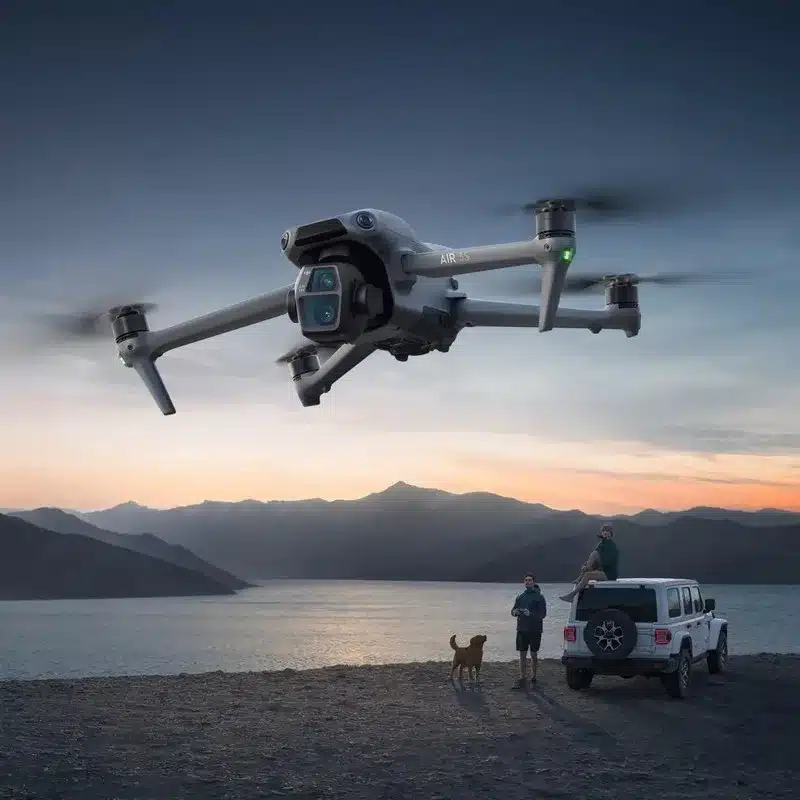
The Air 3S is the long-range drone most people should buy. It’s rated for 20 km of video transmission and up to 45 minutes of flight, enough to scout a location and still get home, and it’s DJI’s current mid-size drone, sold officially in the US.
Its main camera has a 1-inch sensor for better low-light shots, a second 70mm medium tele camera frames distant subjects more tightly, and forward-facing LiDAR adds obstacle sensing at night.
Key specs: 20 km video transmission (FCC) · up to 45 min flight · 1-inch main camera plus 70mm medium tele · 4K/60fps HDR video · omnidirectional obstacle sensing with LiDAR · about $1,100 with the RC-N3 controller on Amazon
Best for: most people who want long range, long flights and a great camera in a drone that folds into a small bag.
Autel EVO 2 Pro V3

If you’d rather not fly DJI, Autel’s EVO 2 Pro V3 is the strongest alternative. Its SkyLink 2.0 transmission is rated for 15 km (9 miles) and switches between three frequency bands, including 900 MHz, to fight interference, and it flies for up to 40 minutes.
The 1-inch Sony sensor records 6K video with an adjustable f/2.8–f/11 aperture, and 12 vision sensors give it 360-degree obstacle avoidance. It has no geofencing, so it’s up to you to check where you’re allowed to fly.
Key specs: 15 km video transmission · up to 40 min flight · 1-inch sensor, 6K video, f/2.8–f/11 · 360° obstacle avoidance · Smart Controller SE included · about $2,100 on Amazon
Best for: pilots who want a non-DJI drone with long range and a pro camera.
DJI Mini 5 Pro
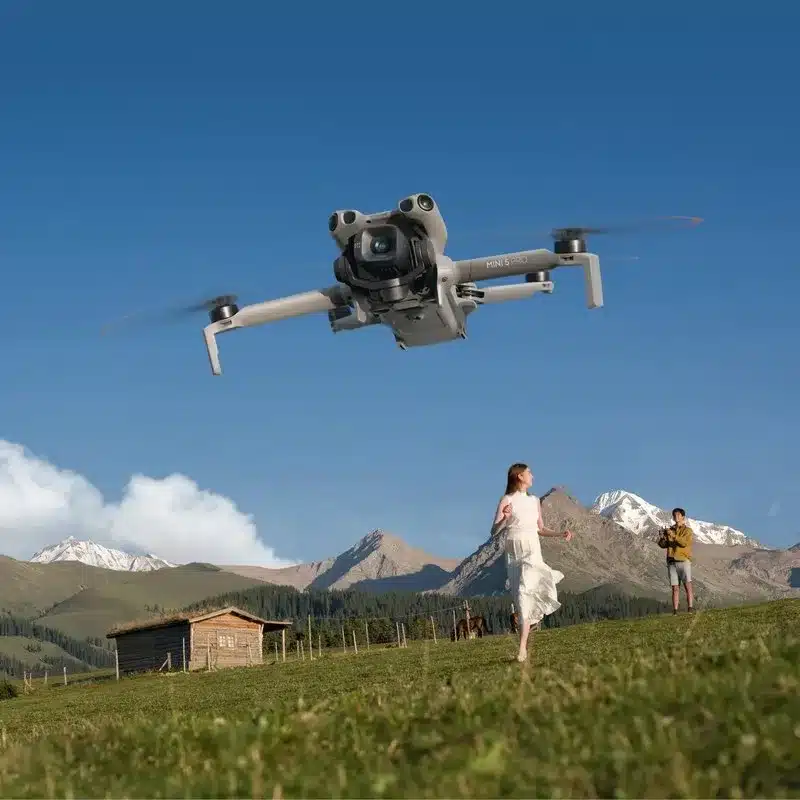
The Mini 5 Pro puts a 1-inch sensor in a drone that weighs about 249.9 g and folds small enough for a pocket. DJI rates its O4+ video link at up to 20 km where FCC rules apply, and its flight time at up to 36 minutes per battery.
Omnidirectional obstacle sensing with a forward-facing LiDAR sensor works at night and during return-to-home, and the gimbal rotates for true vertical shots. DJI hasn’t officially launched the Mini 5 Pro in the US, so Amazon listings come from other sellers; check who’s selling it and what warranty you get. At about 249.9 g, give or take 4 g, it sits right on the 250 g registration line.
Key specs: 20 km video transmission (FCC) · up to 36 min flight · 1-inch sensor, 4K/60fps HDR · omnidirectional sensing with LiDAR · about 249.9 g · about $1,100 for the Fly More Combo on Amazon
Best for: travelers who want the best camera in the smallest drone.
DJI Mini 4K
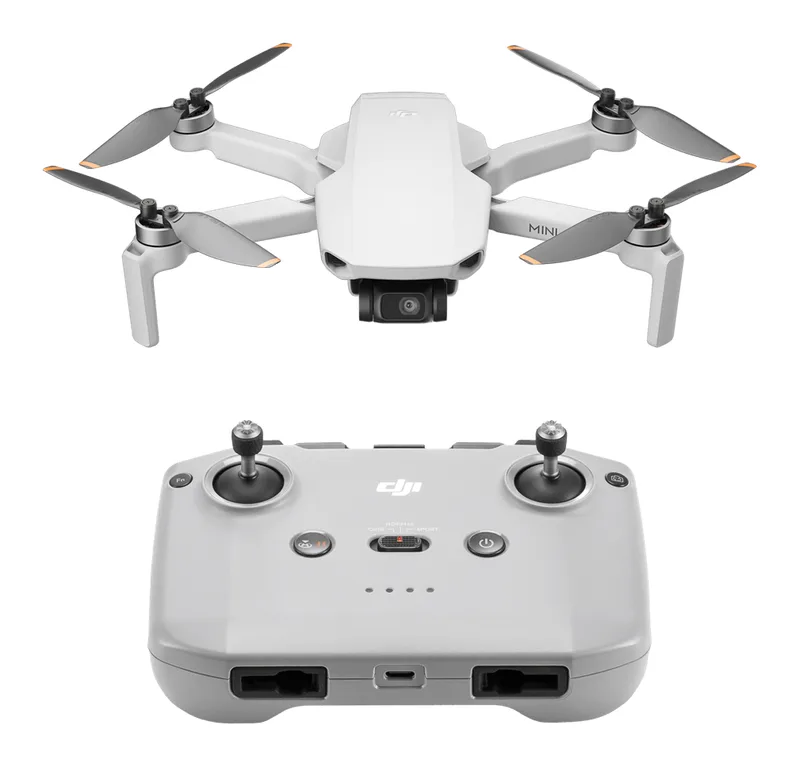
The Mini 4K is the cheapest way into long-range flying. It keeps the basics that matter, a 10 km video link and GPS return-to-home, in a drone that weighs under 249 g, so in the US it needs no FAA registration or Remote ID for recreational flying.
Its 1/2.3-inch, 12-megapixel camera records 4K at up to 30 frames per second and does its best work in good light, and it holds steady in winds up to 38 km/h. The standard package has one battery rated for 31 minutes.
Key specs: 10 km video transmission · up to 31 min flight · 4K/30fps, 1/2.3-inch sensor · under 249 g · about $300 on Amazon
Best for: beginners and anyone on a budget.
How to get the most out of your drone’s range
- Fly in open areas, away from dense buildings, power lines and crowded Wi-Fi.
- Angle the controller’s antennas the way the manual shows, so they face the drone.
- Fly a little higher for a clearer path to the drone, while staying under 400 feet.
- Set the return-to-home altitude above the tallest trees and buildings before you take off.
- Turn back with plenty of battery left; flying into a headwind on the way home drains it fast.
- Don’t modify antennas or transmitter power: it can break FCC rules and void your warranty.
Conclusion
For most people, the DJI Air 3S is the best long-range drone you can buy in the US: 20 km of rated range, 45 minutes in the air and a 1-inch camera. Autel’s EVO 2 Pro V3 is the strongest non-DJI option, the Mini 5 Pro packs the best camera into the smallest drone, and the Mini 4K is the budget way in.
Whatever you fly, the rules matter more than the spec sheet: keep the drone in sight, stay under 400 feet, and bring it home with battery to spare.
Frequently asked questions
It depends on the drone. Toy drones reach about 100 m; mini camera drones like the DJI Mini 4K are rated for about 10 km of video transmission, and drones like the DJI Air 3S and Mini 5 Pro for up to 20 km in ideal conditions under US rules. Obstacles and interference cut that sharply, and US rules require you to keep the drone in sight.
Among camera drones sold in the US, the DJI Air 3S and Mini 5 Pro are rated for up to 20 km of video transmission (FCC), and the Autel EVO 2 Pro V3 for 15 km. Purpose-built long-range FPV drones and commercial fixed-wing drones fly much further.
Only as far as you can see it. FAA rules require recreational and commercial pilots to keep the drone within visual line of sight and below 400 feet; flying beyond that needs an FAA waiver.
No. Since December 2025, new foreign-made drone models can’t get the FCC approval needed for sale, but drones approved before then, such as the DJI Air 3S and Mini 4K, can still be sold, owned and flown.
Not by modifying it: changing antennas or transmitter power can break FCC rules. You get the most from the range you have by flying in open areas away from interference, angling the controller’s antennas toward the drone, and starting back with plenty of battery.
Most camera drones, including all four in this guide, fly themselves back with GPS return-to-home when they lose the signal or the battery runs low. Set the return altitude above any trees or buildings before you fly.
Most camera drones fly for 30 to 45 minutes per battery in calm conditions: 31 minutes for the DJI Mini 4K, 36 for the Mini 5 Pro, 40 for the Autel EVO 2 Pro V3 and 45 for the DJI Air 3S. Wind and cold shorten it.
In the US, drones flown for fun must be registered with the FAA if they weigh 250 g or more, and registered drones must broadcast Remote ID; lighter drones like the DJI Mini 4K don’t need to be. Commercial pilots register every drone and need a Part 107 certificate.
As an Amazon Associate, Artistic Hive earns from qualifying purchases.