Movie prop weapons are part of production design: their silhouette, finish and relation to costume help establish a fictional world. This guide examines documented film objects as visual design. It does not explain weapon operation, modification or on-set handling.
Start with a documented object
A film title and a familiar-looking object are not enough to identify an individual prop. Productions can use multiple versions, and later replicas may differ from screen-used pieces. A museum accession record, production archive or documented maker account is stronger evidence than an unattributed image caption.
The Royal Armouries collection feature supplies the four examples below. Its identification and provenance support the historical notes; the visual interpretations are our commentary, not claims about the filmmakers’ intentions.
| Documented example | Provenance supported by the museum | Design observation |
|---|---|---|
| M-41A pulse rifle, Aliens (1986) | Collection object XII.11846; the museum credits Simon Atherton working to James Cameron’s design and notes later use in Alien 3. | A worn, industrial finish helps the object belong to an environment of heavy equipment rather than polished consumer technology. |
| Captain Nemo’s long prop, The League of Extraordinary Gentlemen (2003) | Collection object XII.11937; the museum documents Bapty’s production work. | Silver-and-white ornament links the object visually to Nemo’s other elaborate possessions. |
| E-11 blaster, Star Wars | The museum identifies the Stormtrooper prop design in its collection feature. | A dark, repeated silhouette reinforces the uniformity of an organized force. |
| Captain Nemo’s decorated sidearm, The League of Extraordinary Gentlemen | Collection object XII.11938, documented in the same feature. | Decorative surfaces make the object read as a character possession rather than anonymous equipment. |

Analyze what the image actually shows
- Identify the film, year, character and source for the pictured object. Separate screen-used object, replica and illustration.
- Describe the silhouette, color, material impression and wear visible in the reference. Do not infer hidden mechanics from appearance.
- Compare the object with costume, set and vehicle design. Look for repeated shapes or finishes.
- Inspect how framing and light guide attention. A close-up may reveal ornament that disappears in a wide shot.
- State whether a conclusion is a documented production choice or your interpretation.
Why a screen object becomes recognizable
A useful movie prop does a job in the scene as well as occupying a frame. It may identify a character, make a choice visible, establish a profession or give a performance something concrete to act on. Recognition can come from a silhouette, a repeated color, a distinctive scale or the way the object is introduced and used.
The four museum cases above offer a controlled comparison. The repeated dark form of the Stormtrooper design can be read alongside repeated costume shapes. Nemo’s ornamented objects invite comparison with a more individualized costume and environment. The industrial appearance of the pulse-rifle design can be compared with surrounding equipment. These are visual readings, not statements that the makers documented those exact intentions.
Eight recognizable screen props, read as design
These props are famous mainly for how they look on screen. The notes describe what the audience sees, not how anything works.
Dirty Harry (1971). Harry Callahan’s Smith & Wesson Model 29 revolver has a long barrel that looks oversized in Clint Eastwood’s hand. The object exaggerates the character.

James Bond’s Walther PPK. Bond is issued the PPK in Dr. No (1962). Its small, flat shape disappears under a tailored suit, which suits a spy who is meant to pass as a businessman. Skyfall (2012) adds a palm-print grip that only Bond can use.

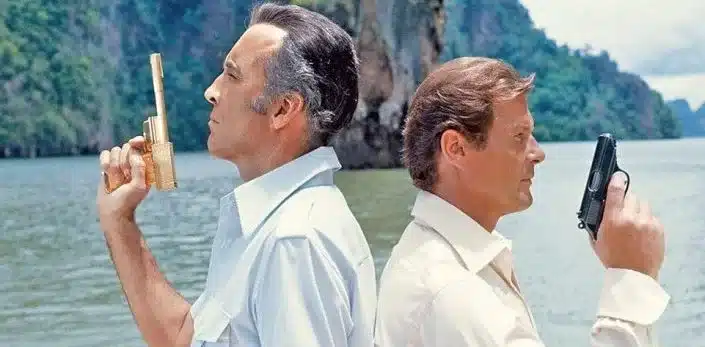
The Man with the Golden Gun (1974). Scaramanga’s gold gun is assembled from a pen, a lighter, a cigarette case and a cufflink. The gold finish advertises the villain’s vanity.
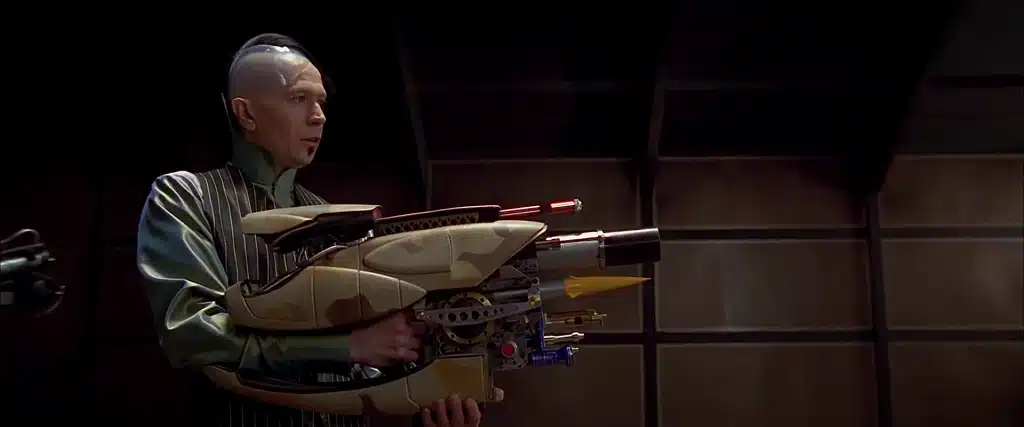
The Fifth Element (1997). Zorg’s ZF-1 is bulky, cream-colored and crowded with extra parts, a comic exaggeration that matches the film’s colorful future.
Judge Dredd (1995). The Lawgiver has a squared, armored shape and a red display strip that echo the Judges’ uniforms.

Men in Black (1997). The Noisy Cricket is a tiny, toy-like silver prop. The joke depends entirely on its size.

Constantine (2005). John Constantine’s gold shotgun is shaped like a cross, turning a religious symbol into equipment.

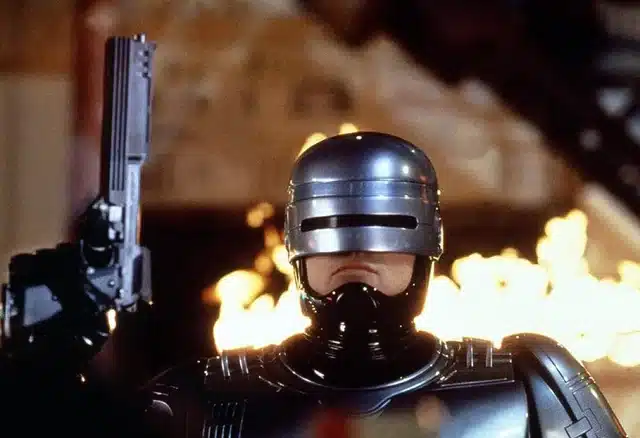
RoboCop (1987). The Auto-9 is a long, angular pistol that is stored in a compartment in RoboCop’s leg, so the prop becomes part of the character’s body.
Separate design, prop identity and screen appearance
| Claim | Evidence needed | Safer wording when evidence is limited |
|---|---|---|
| This design appears in a film. | A reliable production/collection source or identifiable screen reference. | “A reference to the design associated with…” |
| This individual object was used in production. | Object provenance, accession or a documented maker/production history. | State exactly what the collection record says. |
| This is the object visible in a particular shot. | A supported match between the object and that shot. | Do not infer an exact screen match from a similar silhouette. |
| The director intended a particular meaning. | A relevant first-person production account. | “The design can suggest…” or “In this reading…” |
The Royal Armouries feature supports the collection identifications above. It also shows why a design history and an individual object’s later reuse need to be recorded separately. A replica can be useful for studying visual form while still being the wrong evidence for a screen-used provenance claim.
Read the object at three shot sizes
In a wide shot, look for silhouette and contrast against costume or setting. Small surface detail may disappear. In a medium shot, look at the object’s scale relative to the performer and how it sits within the action. In a close view, material, ornament, wear and text become more visible. A design should be analyzed at the scale at which the film asks the audience to notice it.
Light can emphasize or conceal those properties. A glossy surface may produce a strong highlight that competes with a face, while a dark surface may merge with a costume. A rendering or catalogue photograph under neutral lighting cannot establish how the object reads in every scene.
Track the prop’s changing state through a story
For a harmless fictional example, a courier’s message scanner begins clean, acquires a cracked status cover and later has a temporary repair. Those states can reveal what happened without explanatory dialogue. They also create a continuity task: the correct version must appear in each scene even when scenes are filmed out of order.
Record the state required at the start and end of each scene, reference photographs and any visible change during the action. Distinguish a deliberate story change from a reset error. The same discipline applies to a letter becoming folded, a cup emptying or a case changing hands; distinctive objects do not need to be weapons to carry narrative information.
Use a comparison instead of a ranking
Rather than declare one prop the “most iconic,” ask what makes two objects readable in different ways. Compare repeated versus unique shape, clean versus worn surface, anonymous equipment versus personal possession, and immediate recognition versus a delayed reveal. Keep the evidence for identity separate from your interpretation of the design.
This approach makes a prop study useful to a filmmaker or illustrator: it identifies a decision that can be applied to an original object without copying a famous design.
An original design exercise
Imagine a fictional courier in a rain-worn city carrying a harmless message scanner. Give the scanner a rounded grip, a chipped yellow housing and an oversized status lamp. The yellow can connect it to municipal equipment, while the worn finish suggests repeated use. These are invented design choices for a non-weapon prop, not details of a historical film object.
Draw three silhouettes and test whether the object remains readable at the intended shot size. Then compare a clean and a weathered surface. This exercise teaches visual consistency without copying a protected design or implying functional realism.
Use references with accurate credit
Link to a museum record when you cannot establish permission to reproduce its photograph. A public collection webpage is not a blanket image license. Keep the image creator, rights terms, object identification and access date with any approved reproduction.
These selected museum cases provide a limited introduction to film-object design.
Continue with lens choices and storytelling, wide-shot composition and the cinematographer’s role to connect object design with how it appears on screen. Actual production safety and specialist handling belong to qualified professionals and the production’s procedures.