Updated November 2026. The best point-and-shoot film camera for most people is a used Olympus mju-II (sold in the US as the Stylus Epic): a sharp 35mm f/2.8 lens, quick autofocus, a splash-proof shell and a body that fits in a jeans pocket. If you’d rather buy new with a warranty, the Pentax 17 is the best-built new film compact, and the Kodak Snapic A1 is the best one under $100.
Our picks at a glance
- Best overall (used): Olympus mju-II, autofocus, f/2.8 and pocket-sized
- Best premium (used): Contax T2, a Zeiss Sonnar lens, titanium body and a manual focus dial
- Best new camera: Pentax 17, half-frame, 72 photos per roll
- Best new under $100: Kodak Snapic A1, full-frame 35mm with two-zone focus and double exposures
- Best cheap half-frame: Kodak Ektar H35N, with a bulb mode for night shots
- Cheapest reusable: Ilford Sprite 35-II, a step up from a disposable
- Best for wet trips: Canon Sure Shot WP-1, a water-resistant body (test the seals first)
- Best classic without autofocus: Olympus XA2, tiny, with simple zone focus
- Also worth a look used: Yashica T4, Leica Minilux and Nikon L35AF
We compared each camera’s lens, focus, exposure control, flash and battery using the makers’ specifications and reference sources, and checked what Amazon US sells today (November 2, 2026). The new cameras come with a warranty. The used ones were made in the 1980s and 1990s, so read how to buy a used point-and-shoot before you spend collector money.
Advantages of Using Point and Shoot Film Cameras
Transitioning from the introductory charm of film photography, let’s dive into why we hold point and shoot film cameras in high regard. These little marvels pack a powerful punch for photographers at all skill levels.
They embody simplicity, offering a straightforward approach to capturing life’s moments. Just load your film, aim at your subject, and click – it’s that effortless with the best point and shoot camera film.
The advantages extend beyond ease of use: these cameras are usually more affordable than their SLR counterparts, making them an attractive option for those on a budget or just starting out.
With models like the best cheap point and shoot film camera available, you can explore photography without breaking the bank. Additionally, their compact sizes make them excellent travel companions; slip one into your pocket or purse, and you’re ready to document adventures anywhere you go.
Lugging around heavy equipment becomes a thing of the past as these cameras epitomize portability while still delivering stunning 35mm quality images that digital often struggles to match in character.
Contax T2

The Contax T2 is a popular point and shoot film camera known for its premium build quality, sharp Carl Zeiss lens, and advanced autofocus system. It’s a favorite among photographers for its compact size and impressive image quality.
Key specs: Carl Zeiss Sonnar T* 38mm f/2.8 lens · active infrared autofocus plus a manual focus dial · aperture priority from f/2.8 to f/16, shutter 8 s to 1/500 s · ±2 EV exposure compensation · built-in flash · one CR123A battery · launched in 1990.
Features & Description
We’re excited to share the features of the Contax T2, a high-end point and shoot film camera that really stands out from the crowd. Its Carl Zeiss Sonnar T* 38mm f/2.8 lens is renowned for capturing sharp images with beautiful contrast.
You’ll find its aperture priority setting allows for great control over depth of field, making it an excellent choice for both beginners and seasoned photographers looking for the best point and shoot 35mm film camera.
The design of the Contax T2 exudes elegance without sacrificing functionality. A minimalist top plate houses LCD screens providing exposure information at a glance, while easy-to-use dials allow quick adjustments for exposure compensation and focus settings.
Additionally, this camera’s titanium body not only looks sleek but also offers durability along with a comfortable weight that makes it ideal for all-day shooting.
On practicality, Contax didn’t skimp on useful features like a built-in flash known to perform exceptionally well in low-light conditions or backlit scenes.
The bottom reveals simplicity—here lies a standard tripod socket next to battery compartment as well as manual rewind button—a nod to traditional photography enthusiasts who prefer hands-on interaction with their tool.
Pros & Cons
We love the Contax T2 for its impressive features, but like all cameras, it has its drawbacks too. Let’s dive into what makes this camera stand out and what might hold you back.
- The Contax T2 boasts a high – end Carl Zeiss Sonnar T* 38mm f/2.8 lens that captures sharp images with beautiful bokeh, making it one of the best point and shoot film cameras for enthusiasts.
- Its titanium body is not only sleek but provides a solid weight and grip, enhancing the overall feel and durability of the camera.
- Users appreciate the minimal and functional top layout which includes an LCD screen, exposure compensation dial, and clearly marked shutter button, streamlining the shooting process.
- This camera comes equipped with a built – in flash and an aperture ring that allow photographers to shoot in a variety of lighting conditions.
- The autofocus system can be slow and picky, which might frustrate users who want to capture quick moments; however, there is a manual focus option for those who prefer more control.
- A notable downside is the loud auto advance feature that activates after each shot without an option to disable it; this could be distracting in quiet environments or when discretion is needed.
Olympus Mju II

The Olympus Mju II is a compact and stylish point and shoot film camera that is perfect for beginners. It features a sharp 35mm f/2.8 lens, autofocus capabilities, and a weatherproof design, making it ideal for travel photography.
Key specs: 35mm f/2.8 lens (four elements) · autofocus down to 0.35 m · spot metering · splash-proof body of about 145 g · built-in flash · one CR123A battery · reads DX-coded film · launched in 1997.
Features & Description
We love how the Olympus Mju II makes photography fun and easy for everyone. This camera’s compact and weatherproof design means you don’t have to worry about taking it along on a beach day or a rainy city walk.
Its durability stands up to our unpredictable adventures, making it the best point-and-shoot film camera for travel enthusiasts on a budget.
With its sharp 35mm f/2.8 lens, this little gem captures vibrant photos that you’ll want to keep forever. It includes various flash modes to help snap that perfect shot in any lighting condition which is ideal when we’re out at concerts or capturing memories during night-time escapades.

Plus, with automatic exposure control, even beginners can feel like pro photographers without fussing over complicated settings.
Let’s move onto the pros and cons of the Olympus Mju II – because while this camera might be an affordable option among its peers, we’ve discovered some insights you’ll want to hear before clicking that shutter button.
Pros & Cons
The Olympus Mju II, also known as the Olympus Stylus Epic, is an exceptional point-and-shoot film camera with several advantages and a few limitations.
- Compact Size: The Mju II’s small form factor makes it highly portable and easy to carry around for spontaneous photography sessions.
- Simple Operation: Its intuitive design and easy-to-use controls make it an ideal choice for beginners or individuals who prefer a straightforward shooting experience.
- High-Quality Lens: The Mju II is equipped with a sharp lens that delivers impressive image quality, allowing users to capture clear and detailed photos.
- Weatherproof Construction: This feature provides added protection against the elements, making the camera suitable for various outdoor shooting conditions.
- Limited Manual Control: While its automated functions are convenient, some users may find the lack of manual control options restrictive for certain creative needs.
- Battery Dependence: The reliance on batteries for operation can be a drawback in situations where access to replacements may be limited or inconvenient.
Yashica T4
The Yashica T4 is a compact point and shoot film camera known for its sharp Carl Zeiss Tessar lens and automatic flash. It’s a popular choice for street photography and is praised for its simple operation and excellent image quality.
Key specs: Carl Zeiss Tessar 35mm f/3.5 lens · autofocus · automatic exposure · built-in flash · one CR123A battery. The later T4 Super is weatherproof against light rain.

Features & Description
The Yashica T4 presents a user-friendly and straightforward point-and-shoot film camera option. It boasts a Carl Zeiss Tessar 35mm f/3.5 lens, auto-exposure, built-in flash, and a 3-point infrared active autofocus system.
These features make it an excellent choice for capturing sharp and atmospheric images with ease. The direct flash look favored by fashion photographers is one of the notable attributes of the Yashica T4, contributing to its ability to produce sharp images with rich colors.
Additionally, this compact and lightweight camera has earned praise for its portability and ease of use, making it an ideal tool for capturing spontaneous moments and creating a nostalgic film aesthetic.
Pros & Cons
After exploring the features and description of the Yashica T4, let’s dive into its pros and cons.
- Captures incredibly sharp images with a Carl Zeiss Tessar 35mm f/3.5 lens.
- The built-in flash ensures well-lit photos in various lighting conditions.
- Its auto – exposure feature optimizes the exposure for each shot, eliminating guesswork.
- Features a 3 – point infrared active autofocus system for quick and accurate focusing.
- Limited manual control options may restrict creative experimentation.
- Prices rose sharply during the film revival, so it now costs far more than most point-and-shoot film cameras.
Nikon L35AF
The Nikon L35AF is a compact and lightweight point and shoot film camera that offers easy operation and good image quality. It features a sharp 35mm f/2.8 lens, an autofocus system, and automatic exposure control, making it a great option for beginners or casual photographers.
Key specs: 35mm f/2.8 Nikon lens · infrared autofocus · automatic exposure · film speed set by hand from ISO 50 to 1000 · built-in flash · two AA batteries · launched in 1983.
Original L35AF bodies are only sold secondhand; the link here goes to a renewed Nikon One Touch, also listed as the L35AF II, the updated version with the same 35mm f/2.8 lens.

Features & Description
The Nikon L35AF boasts a versatile 5-element lens with a fast f/2.8 aperture, providing sharp and clear images even in low light conditions. It is equipped with autofocus capabilities, making it effortless to capture spur-of-the-moment shots accurately.
The camera’s automatic film advance ensures smooth operation while its robust build and tactile dials enhance the user experience, allowing for easy adjustments on the go.
Additionally, the Nikon L35AF offers a self-timer for group shots and self-portraits. With its ergonomic design and rugged construction, this camera is an excellent choice for beginners seeking a reliable yet budget-friendly point-and-shoot film camera that delivers exceptional image quality without compromising on convenience or style.

Pros & Cons
The Nikon L35AF boasts automatic focus, exposure, and flash capabilities. It features a sharp 35mm f/2.8 Nikon lens, allowing for clear and detailed images. The camera also offers manual ISO setting and exposure compensation, giving users greater control over their photography.
- Automatic focus ensures quick and precise focusing, ideal for capturing spontaneous moments.
- The sharp 35mm f/2.8 Nikon lens produces high – quality images with excellent clarity and detail.
- Manual ISO setting allows for adjusting the camera’s sensitivity to light, providing versatility in various lighting conditions.
- Exposure compensation feature enables users to adjust the exposure settings based on their creative vision.
- The compact size of the camera makes it portable and easy to carry around for on-the-go photography sessions.
- The bulky design may not be as convenient for individuals seeking a more lightweight and compact option.
- Some users may find the raw, grainy look of the images to be a drawback if they prefer a smoother aesthetic in their photographs.
- Its 80s style aesthetic may not appeal to those looking for a more modern or timeless design in their film cameras.
Leica Minilux
The Leica Minilux is a compact and stylish point and shoot film camera known for its sharp lens and advanced features. It’s perfect for photographers who want premium image quality in a small and easy-to-use package.
Key specs: Leica Summarit 40mm f/2.4 lens · autofocus · built-in flash · one CR123A battery. Check for the lens error described in buying used below.

Features & Description
The Leica Minilux boasts impressive features that make it an excellent choice for photography enthusiasts. Equipped with a LEICA SUMMARIT 40mm f/2.4 lens, this camera ensures high-quality, sharp images with exceptional detail.
The Kepler viewfinder offers 0.35x magnification, allowing for precise composition of shots and enhancing the overall shooting experience.
This point-and-shoot film camera strikes a perfect balance between user-friendly design and advanced functionalities, catering to photographers at all skill levels. Whether you’re a beginner or a seasoned pro, the Leica Minilux provides the tools needed to capture stunning images effortlessly.

Pros & Cons
The Leica Minilux is a top-tier point and shoot film camera that offers exceptional image quality and durability. It may be on the pricier side, but its features justify the cost.
- Superior Image Quality: The Leica Minilux delivers stunning, high-definition photos with rich colors and sharp details, capturing the nostalgic film aesthetic that many photographers crave.
- Robust Build: Crafted with precision engineering, the Minilux boasts a solid construction that exudes durability and reliability, ensuring it can withstand regular use over time.
- Advanced Autofocus System: Equipped with an advanced autofocus system, this camera effortlessly locks onto subjects, making it an ideal choice for photographers who want to capture crisp images quickly and easily.
- Portable Design: The compact and lightweight design makes it convenient to carry around, whether you’re on a casual outing or traveling to different locations.
- Criticism of High Cost: Despite its exceptional performance, the high price tag of the Leica Minilux may deter some potential buyers seeking a more budget-friendly option.
- Limited Availability: Due to its rarity and premium status in the market, finding a brand-new or well-maintained used unit can be challenging for enthusiasts looking to purchase one.
- Niche Appeal: The Leica Minilux may cater primarily to serious photography aficionados given its premium pricing, which might not align with the needs of beginners or those seeking an entry-level option.
Canon Sure Shot WP-1
The Canon Sure Shot WP-1 is a reliable and compact point and shoot film camera that’s perfect for travel or outdoor adventures. With its water-resistant body and easy-to-use features, it’s a great option for beginners or anyone looking for a fuss-free shooting experience.
Key specs: 32mm f/3.5 lens · autofocus from 0.45 m · built-in flash · water-resistant body, usually quoted for shallow water to about 5 m · one CR123A battery.

Features & Description
The Canon Sure Shot WP-1 is a part of the popular Canon Sure Shot series, known for its user-friendly design and reliable performance. It comes equipped with a built-in flash and automatic flash control, making it suitable for capturing moments in various lighting conditions.
The camera is durable and water-resistant: Canon built it for rain, snow, beaches and shallow water, usually quoted as about 5 m. Its seals are now decades old, though, so test it in a sink before you trust it in the sea.
With its AiAF system and 10-second delay self-timer, the Canon Sure Shot WP-1 offers convenient features for capturing that perfect shot. This fully automatic point-and-shoot film camera provides budget-friendly options for analog photography enthusiasts who seek quality and convenience in one package.

Pros & Cons
The Canon Sure Shot WP-1 is a durable and fully automatic point and shoot film camera equipped with a water-resistant design, making it perfect for outdoor adventures. It features an AiAF system, 10-second delay self-timer, and a built-in flash for capturing moments in various lighting conditions. Here are the key pros and cons of the Canon Sure Shot WP-1:
- Water-resistant construction lets you shoot in rain, snow and at the beach (test the seals before you take it underwater).
- Equipped with an AiAF system for precise autofocus, ensuring sharp and clear images.
- The 10-second delay self-timer feature enables group shots or self-portraits without needing an additional accessory.
- Limited control over advanced settings compared to manual film cameras.
- Some users may find the fixed lens restrictive for creative composition.
Olympus XA2
The Olympus XA2 is a compact and lightweight point-and-shoot film camera that offers simplicity and ease of use. With its sharp 35mm f/3.5 lens, the XA2 is perfect for capturing everyday moments with fantastic image quality.
Key specs: 35mm f/3.5 lens · three-zone focus, no autofocus · automatic exposure from 2 s to 1/750 s · no built-in flash (the A11 flash attaches to the side) · two LR44 or SR44 button cells · launched in 1980.

Features & Description
The Olympus XA2 features a 35mm f/3.5 lens, making it a popular choice for street photography due to its compact size and dependable performance. This camera boasts a shutter speed range of 2s to 1/750s, ensuring that you can capture the perfect shot in various lighting conditions.
While lacking exposure compensation, the XA2 comes with a flash mount for low-light situations, allowing you to adapt to different environments effortlessly. With its user-friendly design and affordable price point (usually far less than the premium autofocus compacts), this camera is an excellent option for beginners or casual photographers looking to explore film photography.
For those seeking reliable and versatile performance in capturing stunning images on film, the Olympus XA2 offers just that at an accessible price point.

Pros & Cons
The Olympus XA2 is a small, unassuming, and quick-to-shoot point and shoot film camera with a 35mm f/3.5 lens.
- Lightweight and compact, perfect for on-the-go photography.
- Simple zone focusing makes it easy to capture sharp images quickly.
- Affordable, making it an excellent entry – level choice for film photography enthusiasts.
- Reliable and delivers quality images favored by street photographers.
- Clip-on A11 flash for low light. It isn’t built in, so check that the camera comes with one.
- Tiny batteries: two LR44 or SR44 button cells run the electronic shutter for a long time, but it won’t fire without them.
Pentax 17
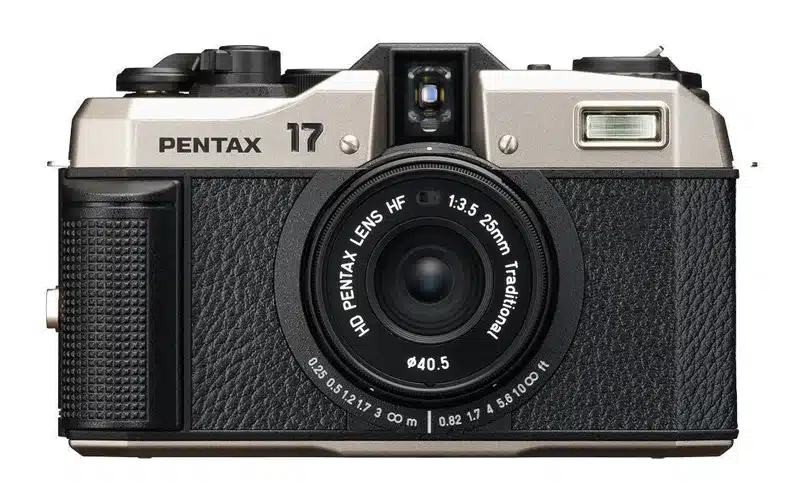
The Pentax 17 is the best-built new film compact you can buy today. Launched in 2024, it was Pentax’s first new film camera in more than two decades.
It is a half-frame camera: it splits each 35mm frame in two, so a 36-exposure roll gives you 72 photos, which halves your cost per picture.
Key specs: 25mm f/3.5 HD-coated lens (about 37mm in full-frame terms) · six-zone focus · automatic exposure, shutter 4 s to 1/350 s plus bulb · ±2 EV exposure compensation · film speeds from ISO 50 to 3200 · built-in flash · manual wind lever · one CR2 battery · 290 g.
Features & Description
Focus is by zone: you turn the lens ring to one of six marks, from close-up to landscape. Exposure is automatic, with ±2 EV compensation for backlit or snowy scenes and a bulb setting for long exposures.
You advance the film with a lever, as on an old SLR, and the top and bottom covers are magnesium alloy. Half-frame pictures are vertical when you hold the camera normally, which suits portraits and street shots and pairs nicely as diptychs.
Pros & Cons
The Pentax 17 costs about five times as much as the Snapic A1, but it is a properly built camera with real exposure control.
- Sold new: A warranty instead of a 30-year-old camera’s unknown history.
- 72 photos per roll: Half-frame halves the cost of film and developing per picture.
- Solid build: Magnesium covers and a smooth wind lever.
- Exposure control: ±2 EV compensation and a bulb setting.
- No autofocus: You set one of six focus zones yourself.
- Smaller negatives: Half-frame shows more grain in big prints.
- Price: It costs far more than the cheap new compacts.
Kodak Snapic A1
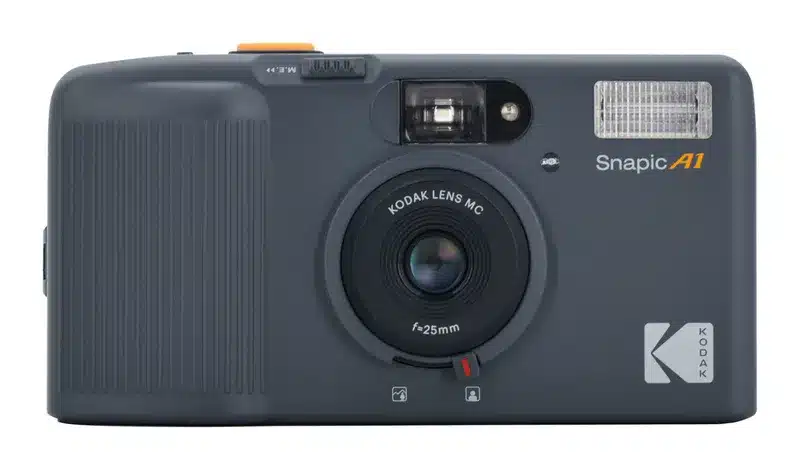
The Kodak Snapic A1 is a new, reusable 35mm point-and-shoot. Unlike the vintage cameras above, it is sold new, so there is no hunting through the used market for a working copy.
It weighs just 117 g and has a wide 25mm lens, which makes it an easy everyday camera for travel, parties and street snapshots.
Key specs: 25mm f/9.5 three-element glass lens · two-zone focus · fixed 1/100 s shutter · built-in flash · double-exposure switch · small OLED display on top · two AAA batteries · $99 on Amazon.
Features & Description
The Snapic A1 keeps things simple. Its 25mm f/9.5 lens uses three glass elements for sharp, detailed photos, and a two-zone focus switch lets you choose between a close-up setting and a distance setting.
The built-in flash fires automatically in low light and has a red-eye reduction mode, while the multiple-exposure function lets you layer two scenes on a single frame.
It runs on two AAA batteries, and the shutter speed is fixed at 1/100 sec, so it does its best work in daylight or with the flash. Film and batteries are not included.
Pros & Cons
The Kodak Snapic A1 trades the manual controls of the premium compacts in this list for simplicity and a much lower price. When using this camera, you can expect the following pros and cons:
- Sold New: You avoid the risks of buying an old secondhand camera.
- Light and Compact: At 117 g, it fits easily in a pocket or bag.
- Creative Features: Multiple exposures and a built-in flash with red-eye reduction.
- Affordable: It costs a fraction of the premium compacts in this list.
- Limited Control: The fixed 1/100 sec shutter gives you no control over exposure.
- No Autofocus: You need to pick the right focus zone yourself.
- Simpler Lens: Its lens can’t match the sharpness of premium compacts like the Contax T2.
Kodak Ektar H35N
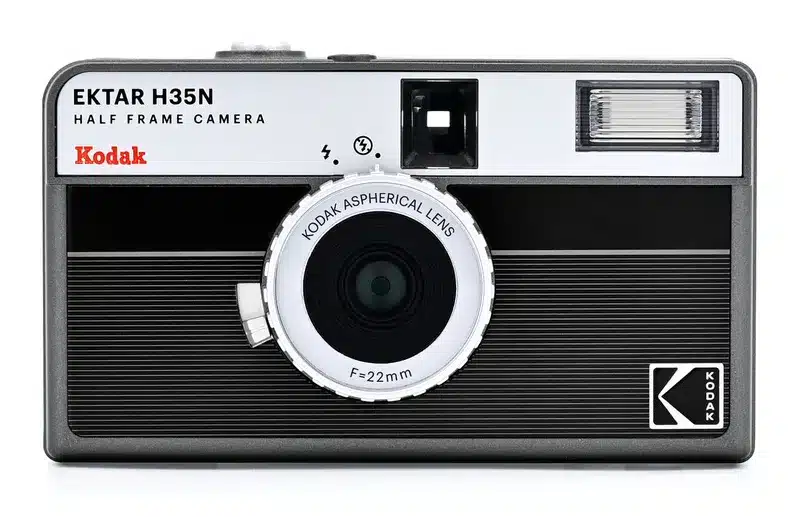
The Kodak Ektar H35N is the cheapest way to try half-frame: 72 photos from a 36-exposure roll, from a camera that costs well under $100.
It is the improved version of the Ektar H35, made under licence by Reto, the company behind Kodak’s current film cameras. Choosing between it and the Snapic A1? See our Kodak Snapic A1 vs Ektar H35N comparison.
Key specs: 22mm lens with a coated glass element · focus-free · fixed 1/100 s shutter plus a bulb mode with a cable release · built-in flash (one AAA battery) · built-in star filter · tripod socket · $64.99 on Amazon.
Features & Description
The N version adds a coated glass lens element, a bulb mode for night shots (you need a cable release and ideally a tripod), a tripod socket and a built-in star filter that turns small lights into four-point stars.
The shutter and aperture are fixed, so load ISO 400 film for daylight and use the flash indoors and in shade.
Pros & Cons
The H35N is a fun, cheap camera rather than a precision tool:
- Very cheap: One of the least expensive new film cameras worth buying.
- 72 photos per roll: Twice the shots from every roll you buy and develop.
- Night options: Bulb mode and a tripod socket for light trails.
- No exposure control: A fixed 1/100 s shutter, so you need the right film for the light.
- Softer pictures: A focus-free lens can’t match a glass autofocus compact.
- Smaller negatives: Half-frame shows more grain.
Ilford Sprite 35-II
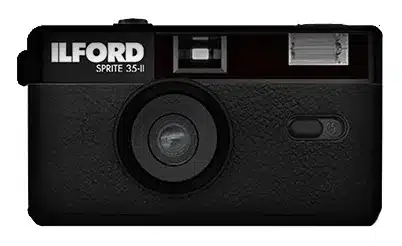
The Ilford Sprite 35-II is a reusable plastic camera that costs little more than a disposable camera, but you can reload it with any 35mm film.
It’s the camera to buy if you want to find out whether you like shooting film before spending real money. Kodak’s M35 and EC35 are similar budget alternatives.
Key specs: 31mm f/9 fixed-focus lens · fixed 1/120 s shutter · built-in flash with about a 15-second recharge · manual wind and rewind · one AAA battery · $38 on Amazon.
Features & Description
Everything is fixed: aim, shoot and wind on. The wide 31mm lens keeps most things from about a metre to the horizon acceptably sharp in daylight.
The flash takes around 15 seconds to recharge, so it’s for the occasional indoor shot, not a run of party pictures. Load ISO 400 film for the best results.
Pros & Cons
The Sprite 35-II does one job, cheaply:
- Cheapest way in: A reusable camera for about the price of a few disposables.
- Any film: Load colour or black and white, and reload as often as you like.
- Simple: No settings to learn.
- No exposure control: Fixed shutter and aperture.
- Basic lens: A single-element lens is soft compared with glass compacts.
- Slow flash: About 15 seconds between flash shots.
New autofocus compacts not on Amazon: Rollei 35AF and Lomo MC-A
Two new cameras bring back the proper autofocus compact with an f/2.8 glass lens. Amazon US doesn’t sell either one, so there’s no button here: buy them from the maker or a camera shop.
Rollei 35AF
Made by MiNT under the Rollei name, the 35AF pairs a five-element 35mm f/2.8 glass lens with LiDAR autofocus (0.7 m to infinity), automatic exposure, a flash that syncs at every shutter speed from 1/2 to 1/500 s and an OLED display, in a 242 g body. It’s the closest a new camera gets to the premium autofocus compacts of the 1990s.
Lomo MC-A
Lomography’s metal-bodied MC-A, launched in October 2025 at $549, has a five-element, multicoated 32mm f/2.8 lens, autofocus plus manual zone focus, aperture control from f/2.8 to f/16 and shutter speeds up to 1/500 s plus bulb.
Point-and-shoot film cameras compared
| Camera | New or used | Lens | Focus | Flash | Battery | Amazon price |
|---|---|---|---|---|---|---|
| Olympus mju-II | Used | 35mm f/2.8 | Autofocus | Built-in | CR123A | Varies |
| Contax T2 | Used | 38mm f/2.8 Zeiss Sonnar | Autofocus + manual dial | Built-in | CR123A | Varies |
| Yashica T4 | Used | 35mm f/3.5 Zeiss Tessar | Autofocus | Built-in | CR123A | eBay |
| Leica Minilux | Used | 40mm f/2.4 Summarit | Autofocus | Built-in | CR123A | eBay |
| Nikon L35AF | Used | 35mm f/2.8 | Autofocus | Built-in | 2× AA | Varies |
| Canon Sure Shot WP-1 | Used | 32mm f/3.5 | Autofocus | Built-in | CR123A | Varies |
| Olympus XA2 | Used | 35mm f/3.5 | 3 zones | Clip-on A11 | 2× LR44 | Varies |
| Pentax 17 | New, half-frame | 25mm f/3.5 | 6 zones | Built-in | CR2 | $496.95 |
| Kodak Snapic A1 | New | 25mm f/9.5 | 2 zones | Built-in | 2× AAA | $99.00 |
| Kodak Ektar H35N | New, half-frame | 22mm | Fixed | Built-in | 1× AAA | $64.99 |
| Ilford Sprite 35-II | New | 31mm f/9 | Fixed | Built-in | 1× AAA | $38.00 |
How to buy a used point-and-shoot without getting burned
The premium compacts in this guide became collector items during the film revival, and their electronics are around 30 years old. A camera that worked last month can fail tomorrow, and some faults are expensive or impossible to repair. Before you buy:
- Buy from a seller who accepts returns: a camera shop, a used-gear dealer or a marketplace listing with a return window. Amazon’s Renewed listings come with Amazon’s Renewed guarantee.
- Ask how it was tested: a shutter that fires doesn’t prove the exposure and focus are right. A recent scan from the camera is the best evidence.
- Check the lens: it should extend and retract without an error. The Leica Minilux is known for an “E02” lens error, usually blamed on a worn ribbon cable.
- Fire the flash and read the LCD: the top display on 1990s compacts can fade or leak with age.
- Look inside the battery door for corrosion.
- Shoot a test roll as soon as it arrives, and get it developed while you can still send the camera back.
One quirk that isn’t a fault: the Olympus mju-II switches its flash back to auto every time you open the lens cover, so turn it off again if you don’t want it.
Which film to load in a point-and-shoot
- ISO 400 colour negative film suits most point-and-shoots: Kodak Ultramax 400 for everyday pictures, Kodak Portra 400 for flattering skin tones. In bright sun, ISO 200 film such as Kodak Gold 200 works too.
- The fixed-shutter cameras (Snapic A1, Ektar H35N, Sprite 35-II) can’t adjust exposure, so ISO 400 film outdoors and the flash indoors gives you the most keepers.
- Use DX-coded film in autofocus compacts such as the mju-II: they read the film speed from the code on the cassette. The Nikon L35AF is different: you set the film speed yourself.
- For black and white, Ilford HP5 Plus is forgiving. See our guide to black-and-white film photography.
- For night and city colour, try CineStill 400D. Read our CineStill 400D review.
- Developing: any lab that handles 35mm film can process these rolls; see where to get film developed. With a half-frame camera (Pentax 17, Ektar H35N), tell the lab, because some scan each half-frame separately and others scan them in pairs.
Conclusion
If you can find a good one, a used Olympus mju-II is still the best point-and-shoot film camera for most people: sharp, quick, tough and small enough to carry every day. If budget isn’t a concern and you want the best lens, the Contax T2 is the classic premium choice.
If you’d rather not gamble on a 30-year-old camera, buy new: the Pentax 17 for the best build and real exposure control, the Kodak Snapic A1 for full-frame 35mm under $100, and the Ilford Sprite 35-II or Kodak Ektar H35N if you just want to try film cheaply.
Whichever you choose, shoot and develop a test roll as soon as it arrives. Most labs email or upload the scans, so the photos can go straight to your phone; our guide to getting film pictures on your phone covers the options, and they work the same for any 35mm roll.
FAQ – Best Point and Shoot Film Camera
For most people, a used Olympus mju-II (Stylus Epic): a sharp 35mm f/2.8 lens, autofocus, a splash-proof body and a pocket-sized shape. The best new one is the Pentax 17, and the best new one under $100 is the Kodak Snapic A1.
The Olympus Stylus Epic, often heralded in the film community, stands as easily one of the best 35mm film cameras due to its sharp lens, compact size, and weatherproof design. It’s incredibly easy to use, making it a favorite among both new and experienced photographers. Its ability to produce high-quality images, even in low-light conditions, has stood the test of time.
Yes, affordable 35mm film cameras such as the Kodak M35 offer a great entry point for beginners. These cameras are pretty straightforward, requiring just a roll of film to start shooting. The simplicity and affordability of cameras like the Kodak M35 make them perfect for those who are new to film photography but want to experience using film without a steep investment.
Ricoh point and shoots, particularly models like the Ricoh GR1, stand out for their exceptional autofocus capabilities, compact design, and sharp lens quality. These cameras feature easy-to-navigate controls and customizable flash settings, catering to both novice and expert photographers who require a reliable, high-quality camera that works effortlessly under various conditions.
Flash settings on a 35mm film camera can greatly impact the quality and mood of the photographs a photographer can capture. Adjustable flash settings allow for greater versatility, enabling photographers to shoot in a variety of lighting conditions. Whether you want flash for nighttime photography or prefer natural light for your shots, having these options at your fingertips is crucial for capturing the desired image.
Yes, on the used market, but expect collector prices and buy from a seller that accepts returns. If you want something similar new, the Rollei 35AF and the Lomo MC-A are new autofocus compacts with f/2.8 glass lenses.
When looking for the best 35mm film cameras, key features to consider include autofocus capabilities, lens quality, manual and automatic settings, durability, and ease of use. Additionally, looking for a camera that offers different flash settings and the ability to change the ISO can provide more flexibility in how and what you shoot, making your camera a joy to use in a variety of settings.
Absolutely. Although digital photography dominates much of the current market, the unique aesthetic, process, and satisfaction of shooting with a 35mm film camera make it a worthwhile investment for many. For photographers who cherish the tactile experience of film, including the anticipation of developing a roll, investing in a 35mm film camera can reignite a passion for the craft and offer a distinct approach to capturing moments.
The Pentax 17 is the best-built new film compact on Amazon (half-frame, zone focus). For autofocus, the Rollei 35AF and the Lomo MC-A are new f/2.8 compacts sold by their makers and camera shops. Under $100, the Kodak Snapic A1 is the pick.
The premium models, such as the Contax T2, Yashica T4, Leica Minilux and Olympus mju-II, haven’t been made for decades. Demand rose with the film revival, and working copies get rarer as their electronics fail. New cameras like the Snapic A1 and Sprite 35-II are the cheap way in.
If you want more photos per roll, yes: a half-frame camera such as the Pentax 17 or Kodak Ektar H35N gets 72 photos from a 36-exposure roll. The trade-off is a negative half the size, so big prints show more grain.
ISO 400 colour negative film, such as Kodak Ultramax 400 or Portra 400, suits most point-and-shoots. Cameras with a fixed shutter need it outdoors. Use DX-coded film in autofocus compacts that read the film speed automatically.
As an Amazon Associate, Artistic Hive earns from qualifying purchases.