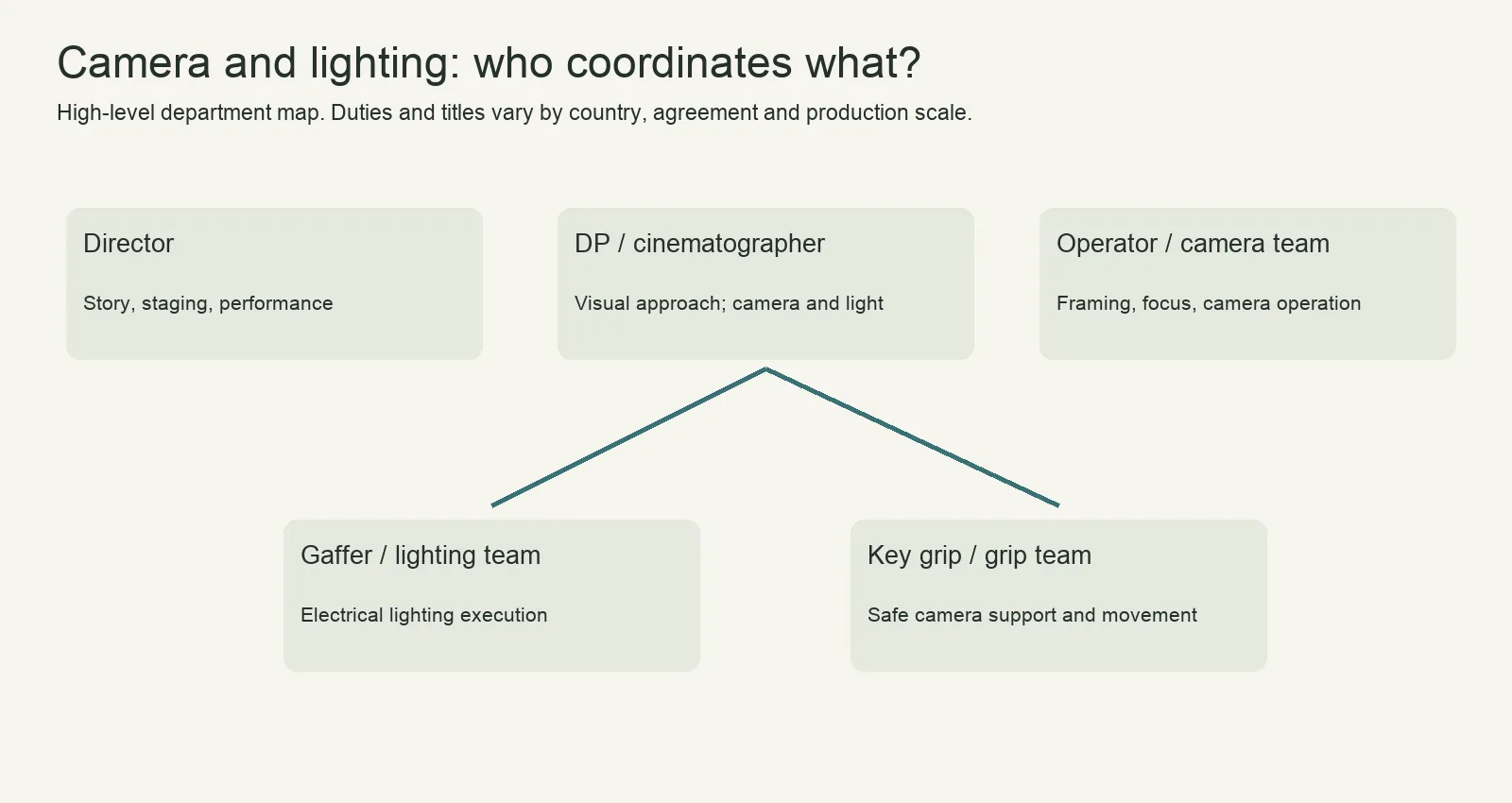
The key grip leads the grip team and coordinates the safe execution of its work with the DP and production. Responsibilities depend on the country, agreement and scale. In the UK source used here, the role centers on camera support and movement; other production systems can assign additional non-electrical light-shaping duties to grips.
| Role | Broad distinction |
|---|---|
| Key grip | Leads grip planning, crew coordination and the assigned support/movement work. |
| Gaffer | Leads electrical-lighting work within the production’s structure. |
| Best boy / deputy | Supports departmental organization and operations; the title and scope vary. |
| Camera operator / camera assistants | Handle camera operation, focus and assigned camera-department work. |
The ScreenSkills key-grip checklist, developed with industry support, describes location assessment, camera movement and coordination. Confirm the actual local job description instead of assuming a US and UK crew chart are identical.
Duties through the production
| Stage | Typical work |
|---|---|
| Prep / recce | Discuss intended shots; assess access, surfaces, restrictions, equipment and staffing with the relevant departments. |
| Before a setup | Confirm the plan, responsibilities and safe working area; coordinate approved equipment and competent crew. |
| During shooting | Communicate movement and setup requirements, monitor the agreed operation and raise concerns when conditions change. |
| Wrap | Coordinate safe breakdown, equipment checks and handoff within the department’s responsibilities. |
A useful high-level example
If a director wants a camera to travel beside a walking performer, the DP defines the visual intention with the director. The grip team assesses the feasible support and movement approach with production and the other affected crew. Sound, access, surface conditions, people and the stopping space all affect the plan. The dolly-shot guide explains the visual purpose of a move; it does not replace competent equipment-specific operation.
This example is illustrative. It is not a credited real-production case study. Do not build overhead supports, vehicle rigs or elevated camera systems from an article diagram; those setups require the production’s competent personnel and appropriate procedures.
What the key grip needs to know at the scout
A camera movement is a visual request before it becomes an equipment plan. The key grip needs the start and end frame, camera height, route, expected speed and performer movement, together with the camera build and available working space. A request to “follow the actor smoothly” leaves important questions unresolved.
On the location visit, identify access routes, surface changes, restricted areas, available setup time and other departments sharing the space. The ScreenSkills checklist explicitly includes location restrictions, camera positions, movement and coordination with suppliers. The outcome should be a feasible plan and an equipment/crew requirement, not just a list of attractive shots.
Translate the shot into responsibilities
| Question | Why it changes the plan |
|---|---|
| Does the camera need to move, or can the framing change another way? | The visual intention determines the support and operating needs. |
| Will performers or extras cross the route? | The movement must be coordinated with blocking and access. |
| Can sound record clean dialogue during the move? | Equipment and surface noise can affect the usable take. |
| How often must the setup be repeated or relocated? | Reset and move time affect staffing and schedule. |
| Who operates, observes and communicates during the move? | Each person needs a defined responsibility and an agreed cue. |
The key grip coordinates the assigned work and raises changes that affect it. If the director lengthens a route, the extension is a new condition to assess, not automatically covered by the earlier plan. Camera, sound, lighting, locations and production may all need to adjust.
Grip equipment is organized by its purpose
Camera-support equipment holds or moves the camera: suitable heads, supports, track and movement systems are selected around the shot and the equipment’s documented limits. In production systems where grips also shape light, flags, diffusion, reflectors and negative fill alter the path or quality of illumination without supplying electrical power.
That light-shaping description is not a universal UK grip job description. Confirm the department allocation on the production. The gaffer’s electrical-lighting responsibilities and the grip department’s assigned support work remain distinct even when their crews must work closely around the same image.
A gear list is not an assembly or load plan. The complete configuration, attachments, movement, environment and people involved determine what competent personnel must assess. The article’s coordination diagram cannot certify any real setup.
Leadership continues after the setup is built
During rehearsal, check whether the proposed operation still matches the action and working area. Confirm who gives movement cues and how a stop is communicated. Report conditions that have changed, such as a blocked route or additional equipment, before repeating the take.
At wrap or a location move, coordinate breakdown, inventory and the condition of equipment within the department’s remit. Document problems for the next use instead of allowing an apparently successful take to conceal a damaged or unreliable item. Production scheduling should account for this work as well as the time when the camera records.
Build experience toward the role
Learn the local department’s terminology, procedures and equipment under appropriate supervision. Keep track of what you have actually operated or assisted with and what remains outside your experience. A key grip must explain constraints, estimate resources and communicate across departments, as well as understand the equipment.
When assessing a course or trainee opportunity, ask which skills it teaches, what supervision it provides and how competence is assessed. A certificate, a personal tool kit and experience on one type of setup answer different questions. None alone establishes readiness to lead every kind of grip work.
Use the skills checklist to identify training and supervised experience you need. Learn the terminology, communication and equipment-handling practices expected by local productions. A course or equipment purchase alone does not establish competence for every rig or movement. Ask how responsibilities and supervision are assigned on the actual job.
Read the DP role guide for the relationship to photography and the first-short-film workflow for where crew planning fits.