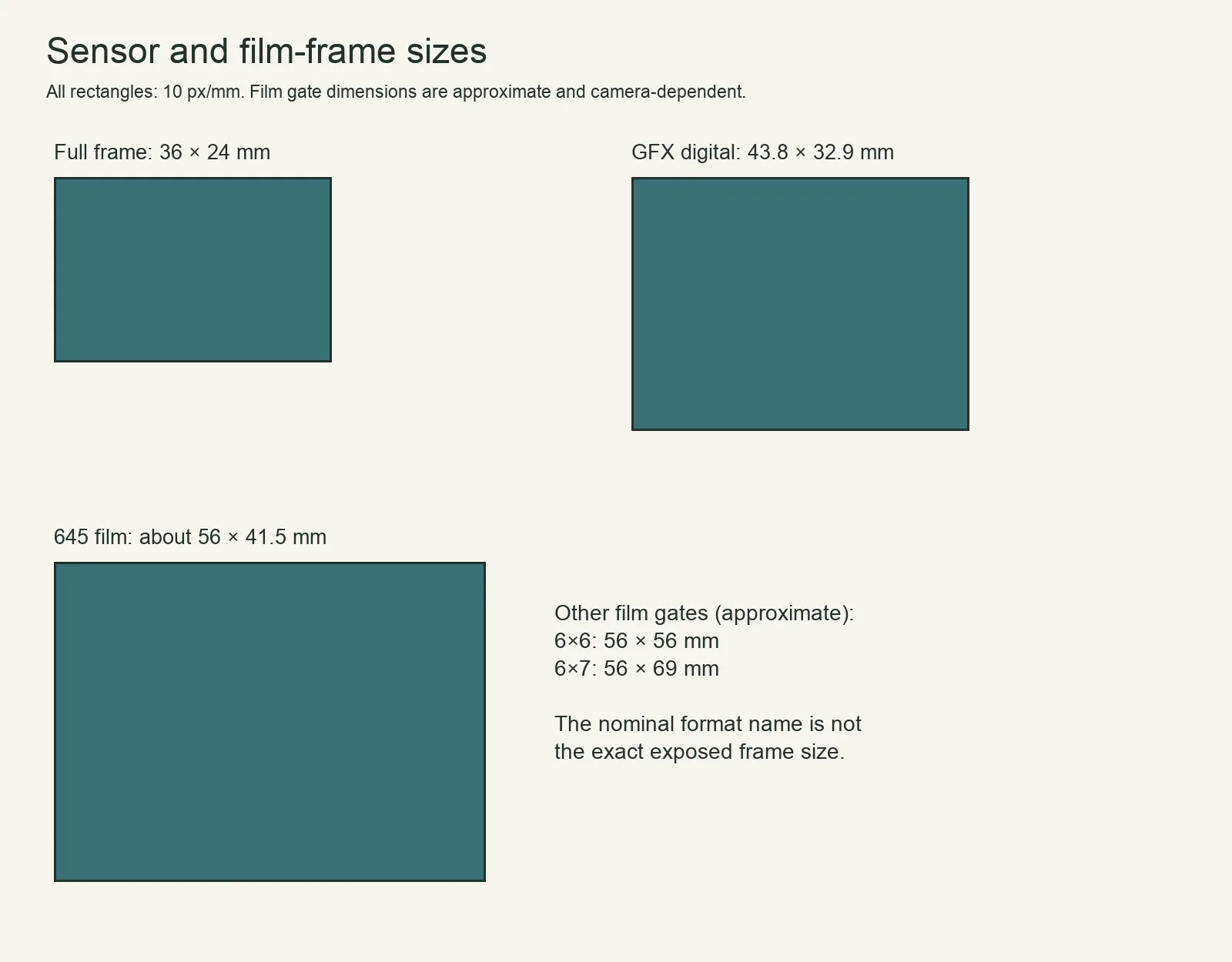
“Medium format” describes several sizes, not one sensor. A 43.8 × 32.9 mm Fujifilm GFX sensor is larger than a 36 × 24 mm full-frame sensor, but smaller than the exposed frame of common 645 film cameras. Compare named cameras and lenses before attributing every difference to format.
| Format | Typical image area | Important qualification |
|---|---|---|
| Full-frame digital / 35 mm still film | About 36 × 24 mm | Native aspect ratio is usually 3:2. |
| Fujifilm GFX digital | 43.8 × 32.9 mm | 4:3; about 1.67 times the area of 36 × 24 mm. |
| 645 film | About 56 × 41.5 mm | Exact gate dimensions vary by camera. |
| 6×6 film | About 56 × 56 mm | Nominal name is not the exact exposed area. |
| 6×7 film | About 56 × 69 mm | Aspect ratio and actual gate depend on the system. |
Fujifilm’s GFX100 specifications document its sensor dimensions. Other digital medium-format systems can have different dimensions.
Equivalent framing and depth of field
For a useful comparison, put the cameras at the same position and compare the same final crop and output size. Different native aspect ratios mean you cannot match both width and height without deciding how to crop.
For example, crop the GFX image to 3:2, giving approximately 43.8 × 29.2 mm. Its linear size is about 1.217 times full frame. A 61 mm lens on that crop gives roughly the field of view of 50 mm on full frame. At the same 3 m focus distance and a common 30 × 20 cm print size, f/4 on GFX gives approximately the depth of field of f/3.3 on full frame, under the same acceptable-sharpness criterion.
This is a geometric example, not a matched lens test. Perspective comes from camera position. Moving backward to match framing changes perspective; changing focal length from the same position does not. Equal f-numbers also do not establish equal total captured light across different sensor areas.
Image quality depends on the camera and the job
Sensor generation, pixel count, readout mode, exposure, lens, processing and final output all matter. A larger sensor does not guarantee better autofocus, wider dynamic range at every ISO, or a visible improvement in a small web image. Compare RAW files from the named bodies at the same framing and output size before paying for a claimed quality advantage.
| Use case | Questions to ask |
|---|---|
| Studio and large prints | Do the resolution, tethering workflow, lens rendering and flash compatibility help this deliverable? |
| Travel | Can you comfortably carry the complete lens and battery kit? Is the required focal range available? |
| Action and wildlife | Check autofocus, readout distortion, burst depth, lens reach and handling on the actual bodies. |
| Film photography | Budget for stock, processing, scanning, frame count and a maintained camera; digital sensor comparisons do not answer those questions. |
Compare the final crop, not only the full sensor
A delivery layout can change how much of either sensor is useful. A square crop from a 36 × 24mm frame uses 24 × 24mm, while a square from a 43.8 × 32.9mm frame uses 32.9 × 32.9mm. Those areas are approximately 576 and 1,082 square millimeters, a ratio of about 1.88. That differs from the 1.67 ratio of the uncropped sensors.
This arithmetic describes retained area, not a measured image-quality gain. Pixel count, lens detail and exposure still matter. For a portrait commissioned in both square and wide layouts, compose and compare those actual crops before deciding which system provides enough room around the subject.
Flash behavior belongs to the shutter system
Do not assume every medium-format camera has the same flash advantage. Hasselblad explains that its XCD lenses use leaf shutters with flash synchronization across their supported shutter speeds. The exact maximum depends on the lens. Fujifilm’s GFX100 II specifications, by contrast, list normal flash synchronization at 1/125 second or slower.
For a daylight portrait, that distinction can influence how you balance ambient light with flash and the aperture you want to use. Check the camera, lens, trigger and flash together, including any high-speed-sync option and its limitations. Sensor size alone tells you none of those compatibility details.
Run a comparison that answers your purchase question
- Choose the difficult deliverable: a large print, a demanding crop, a moving subject or a tethered studio session.
- Use the same camera position and match the final field of view. Decide whether you are matching depth of field or testing the same f-number; those answer different questions.
- Keep lighting controlled and avoid clipping important highlights. Record exposure and focus method instead of comparing unrelated sample photographs.
- Process both files with appropriate input profiles and similar output treatment. Inspect the final print or export at the same size.
- Time the practical work: focus, transfer, selection, editing and backup. Note which limitation actually prevented delivery.
A landscape photographer may value extra cropping room but find that a required lens is too bulky for the planned hike. A studio photographer may care more about tethering reliability and flash compatibility than walking weight. A photographer delivering many event images may prioritize repeatable focus and manageable files. These are system decisions that a generic “medium-format look” cannot settle.
Compare the complete system cost
Price a body, equivalent lens coverage, batteries, media and storage on the same date in the same currency. Add film and scanning costs separately where relevant. This revision does not present a current retailer-price survey or claim hands-on ownership. For concrete system context, see the Canon R5 Mark II specification guide and Canon lens-mount guide. For interiors, compare real-estate lenses by camera mount and equivalent coverage as part of that system budget.
If your comparison includes a used 645 film system, the Mamiya 645 guide provides a specific system to investigate. The camera-history guide gives background on how camera and image formats developed; historical naming alone does not establish a modern sensor dimension.