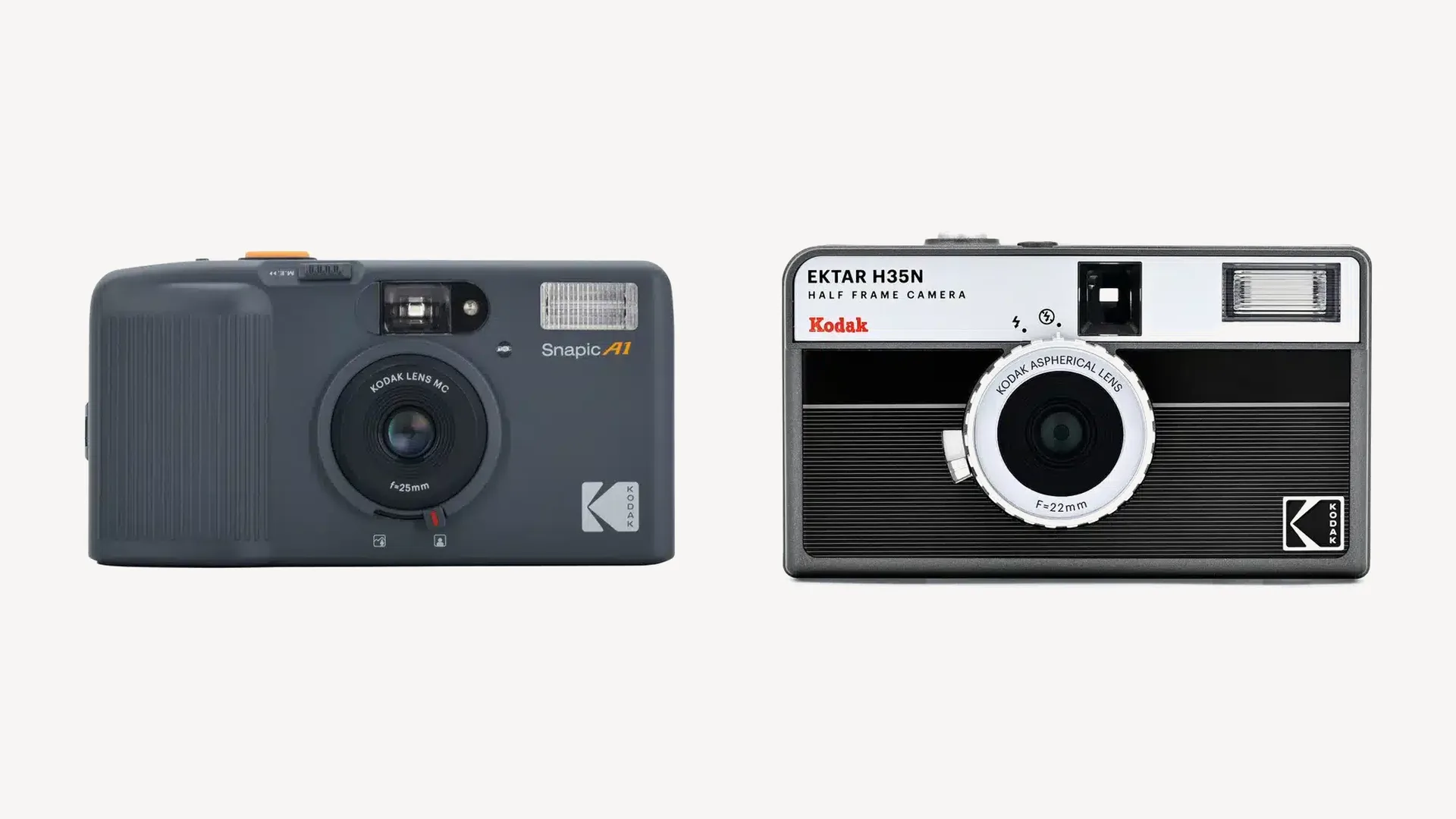
The short answer: buy the Kodak Snapic A1 ($99) if you want the easiest camera to live with: it loads, winds and rewinds the film for you, takes normal full-size 35mm photos and has a three-element glass lens with two focus zones. Buy the Kodak Ektar H35N ($64.99) if you want the most photos for your money: it’s a half-frame camera, so a 36-exposure roll gives you about 72 pictures, and it adds a Bulb setting and a star filter for night shots, but you wind the film by hand.
Both are new, reusable cameras made under licence by RETO, the company behind Kodak-branded film cameras today. Neither has autofocus or adjustable exposure, so the right film and the flash matter more than the camera. Every spec below comes from RETO’s own product pages.
Kodak Snapic A1 vs Ektar H35N at a glance
| Kodak Snapic A1 | Kodak Ektar H35N | |
|---|---|---|
| Format | Full frame (36 × 24mm) | Half frame |
| Photos per 36-exposure roll | About 36 | About 72 |
| Lens | 25mm f/9.5, three glass elements | 22mm f/11 (f/8 with the flash on), one glass and one aspherical acrylic element |
| Focus | Two zones you set by hand: 0.5–1.5 m and 1.5 m to infinity | Fixed focus |
| Shutter | 1/100 s | 1/100 s, plus Bulb for long exposures |
| Film loading and winding | Automatic loading, advance and rewind | You wind and rewind by hand |
| Flash | Built in: on, off or auto, with red-eye reduction | Built in |
| Extras | Double exposures (two per frame) | Star filter, tripod hole, Bulb setting |
| Batteries | 2 × AAA, about 10 rolls of 24 exposures | 1 × AAA |
| Size and weight | 118 × 62 × 35 mm, 117 g | 110 × 62 × 39 mm, 110 g |
| Price (Nov 2026) | $99 | $64.99 |
Full frame or half frame: the difference you’ll notice first
The Snapic A1 uses the whole 36 × 24mm frame, like most 35mm cameras, so a 36-exposure roll gives you about 36 photos. The H35N splits each frame in two, so the same roll gives you about 72 (48 from a 24-exposure roll). That halves your cost per photo.
The trade-off is size: each half-frame negative is half the area, so photos show more grain and less fine detail, which matters more if you print large. Half-frame pictures also come out vertical when you hold the camera normally, so turn it sideways for landscapes. And ask your lab how it scans half-frame film: some scan each photo separately, others scan two side by side.
Which is easier to use?
The Snapic A1. You drop the film in and it winds itself to the first frame, advances after every shot and rewinds the roll at the end. With the H35N you wind on by hand after each photo and rewind the roll yourself, which some people enjoy and others forget to do.
Focus works differently too. The H35N is fixed-focus: keep your subject at least 1.5 m (about 5 feet) away and it will be sharp. The Snapic A1 has two focus zones you choose with a switch, 0.5–1.5 m for close portraits and 1.5 m to infinity for everything else. It focuses closer than the H35N, but only if you remember to flip the switch, and back again afterwards.
Low light, flash and night shots
Both have a fixed 1/100 s shutter and a small aperture (f/9.5 on the Snapic, f/11 on the H35N), so they need bright light. Outdoors in daylight, ISO 400 film is the safe choice for both; indoors and at dusk, use the flash. The Snapic’s flash can fire automatically and has red-eye reduction; on the H35N, switching the flash on also opens the lens to f/8.
The H35N has two tricks for after dark. Its Bulb setting keeps the shutter open as long as you hold the button, for light trails and city lights, which needs a tripod (it has a tripod hole) and ideally a cable release. And its built-in star filter turns small lights into four-pointed stars. The Snapic answers with double exposures: two shots layered on one frame.
Cost per photo
Half frame saves money on every roll. As an example, if a 36-exposure roll costs about $30 once you add developing and scans, that’s roughly 83¢ a photo on the Snapic A1 and 42¢ on the H35N. The H35N is also $34 cheaper to buy. Check your lab’s price first, and ask whether it charges extra to scan half-frame film.
Which film to load
- Everyday: Kodak UltraMax 400. ISO 400 gives these fixed-exposure cameras the most room in mixed light.
- Bright sun only: Kodak Gold 200, warmer and finer-grained, but it struggles indoors and in shade.
- People: Kodak Portra 400 for softer, more flattering skin tones.
- Black and white: Ilford XP2 Super develops at any color lab; Ilford HP5 Plus needs a black-and-white lab. Our black-and-white film guide has more.
Any lab that develops 35mm color film can process the color films above; our guide to getting film developed compares Walgreens, Walmart and mail-in labs, and most labs can send the scans straight to your phone.
What about the Ektar H35 and the Pentax 17?
The original Kodak Ektar H35 ($49.99) is the same half-frame idea for $15 less, but RETO lists it with an all-acrylic 22mm f/9.5 lens and none of the H35N’s extras: no glass element, Bulb setting, star filter or tripod hole. If you want half frame with real exposure control and zone focus, the Pentax 17 costs about $500. Both are in our guide to the best point-and-shoot film cameras.
Our verdict
Choose the Snapic A1 for the simplest experience and full-size negatives: it’s the better gift and the better first film camera for someone who just wants to take pictures. Choose the Ektar H35N if you shoot a lot and want to spend less per photo, or if you like the idea of night shots with Bulb and the star filter, and don’t mind winding by hand.
Kodak Snapic A1
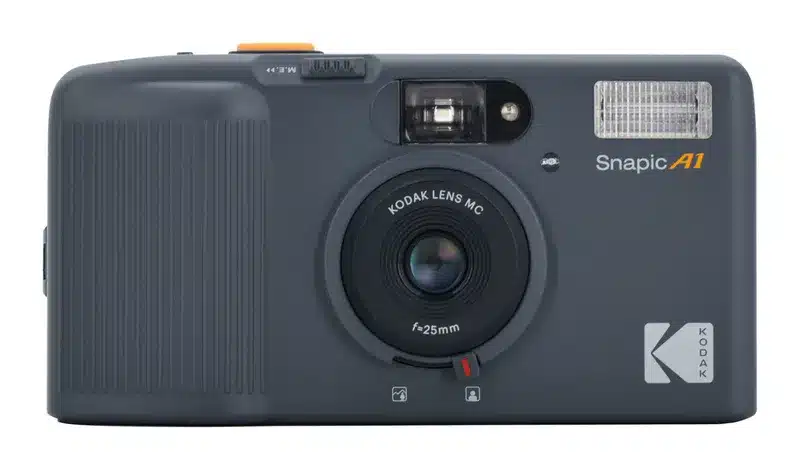
Full-frame 35mm with automatic winding and rewinding, a 25mm f/9.5 glass lens, two focus zones and double exposures. Rhino Grey or Ivory White.
Kodak Ektar H35N
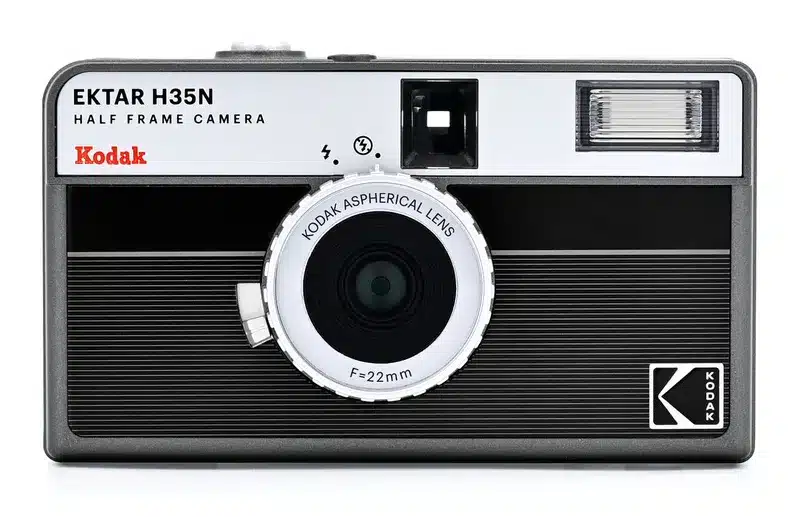
Half frame for about 72 photos per 36-exposure roll, a 22mm lens with a glass element, Bulb setting, star filter and tripod hole. Several colors.
Frequently asked questions
Is the Kodak Snapic A1 better than the Ektar H35N?
It’s easier to use and takes full-size 35mm photos, with automatic winding and two focus zones. The H35N is cheaper, gives you twice as many photos per roll and adds a Bulb setting and star filter. Choose by what you value more: convenience or photos per roll.
How many photos does the Kodak Ektar H35N take?
About 72 from a 36-exposure roll and 48 from a 24-exposure roll, because it’s a half-frame camera.
Does the Kodak Snapic A1 have autofocus?
No. It has two focus zones that you choose with a switch: 0.5–1.5 m for close subjects and 1.5 m to infinity for everything else. It does load, wind and rewind the film automatically.
What batteries do they use?
The Snapic A1 takes two AAA batteries, which RETO says last about 10 rolls of 24 exposures. The H35N takes one AAA battery.
What film should I use in the Kodak H35N or Snapic A1?
ISO 400 color film such as Kodak UltraMax 400 works best in both, because neither can adjust its exposure. Use Kodak Gold 200 only in bright sun.
Can any lab develop half-frame film?
Yes. Half-frame film is ordinary 35mm film and develops the same way. Scanning is the difference: tell the lab it’s half-frame, because some scan each photo separately and others scan two together.
What’s the difference between the Kodak Ektar H35 and H35N?
The H35N adds a glass lens element, a Bulb setting for long exposures, a star filter and a tripod hole. The H35 costs $49.99 and uses an all-acrylic lens.
As an Amazon Associate, Artistic Hive earns from qualifying purchases.