Updated November 2026. The short answer: yes, the Sony FX30 is still worth buying in 2026 if you mainly shoot video. It is still Sony’s current Super 35 cinema camera (no FX30 II has been announced), the August 2025 firmware added useful features, and it sells for about $2,100 body-only at full price, often less on sale. If you also want a viewfinder, a mechanical shutter and burst shooting for photos, the Sony a6700 is the better buy; if you need the cleanest low-light video, the full-frame FX3.
When Sony announced the FX30 cinema camera, we were eager to get our hands on it and put it through its paces. As videographers ourselves, having a compact yet highly capable cinema camera seemed incredibly appealing. After using the FX30 extensively for over 6 months now, we wanted to share our thoughts from a user’s perspective.
Overall, we’ve been extremely impressed with what the FX30 delivers at its price point. The video quality stands right up there with cameras costing way more. Having features like internal 4K 60p recording, dual base ISO, 5-axis stabilization, S-Cinetone profiles and unlimited recording in such a portable package has proved invaluable for our work.
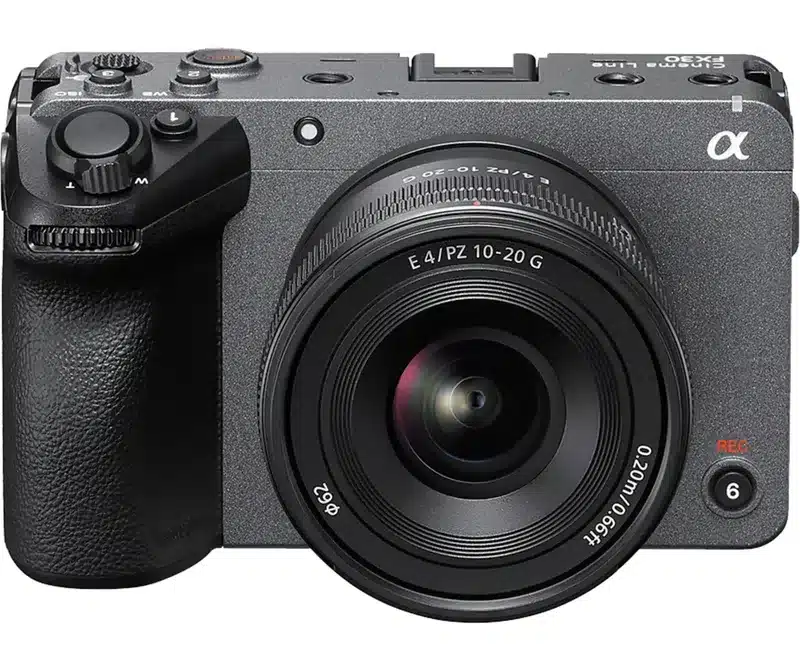
Sony FX30 specs at a glance
| Spec | Sony FX30 |
|---|---|
| Sensor | APS-C (Super 35), 26 MP for photos, 20.1 MP used for video |
| Video | 4K up to 60p from 6K, 4K 120p with about a 1.6x crop, Full HD up to 240p |
| Recording | XAVC HS, XAVC S and XAVC S-I, 10-bit 4:2:2; 16-bit RAW over HDMI to an external recorder |
| Log and color | S-Log3, S-Cinetone, HLG, user LUTs |
| Base ISO | 800 and 2500 (S-Log3) |
| Stabilization | In-body sensor-shift stabilization |
| Cards | Two slots, each for CFexpress Type A or SD (UHS-II) |
| Ports | Full-size HDMI, USB-C (10 Gbps, USB power delivery), mic and headphone jacks; no SDI |
| Viewfinder and ND | No viewfinder, no built-in ND filters |
| Shutter | Electronic only |
| Battery | NP-FZ100; Sony rates it at about 115 minutes of actual shooting, 175 minutes of continuous recording |
| Weight | 646 g (1.4 lb) with battery and card |
Shooting Handheld and Run-and-Gun with the FX30
One of our favorite things about the FX30 is its handheld shooting capabilities. The lightweight magnesium body weighs only 1.4 lbs, making it very comfortable to shoot with over extended periods. Being able to tilt and rotate the screen lets us properly monitor and frame up shots from all kinds of angles.

Having the 5-axis in-body stabilization has been a total game-changer for getting smooth handheld footage. We’re able to walk around with the FX30 and capture very usable 4K clips without any gimbals or supports. This lets us work much faster and get more dynamic, engaging perspectives.
For example, when filming a recent music video we were able to follow the lead singer through narrow hallways and get right in the action during the chorus. The stabilized footage let us add energy and motion to the video in a way that would’ve been impossible before with a larger cinema camera.
The IBIS also helps a ton when having to shoot in low light situations with slower shutter speeds. We filmed a corporate event that had tricky stage lighting. Being able to handhold down to 1/30s shutter speed and still get acceptably steady footage was a lifesaver. This gave us much better exposure control compared to having to stick with 1/60s or higher.
We cover a lot of live events, so having unlimited recording on the FX30 is amazing. We can record hour-long performances, speeches, conferences and more without worrying about overheating. This has taken so much stress out of our event filming. The built-in cooling system works flawlessly.
Recently we filmed a 2 hour music festival concert that involved constantly moving around to capture different angles. The FX30 nailed focus quickly, handled the changing stage lights, and never missed a beat recording wise. Being able to deliver a continuous 2 hour concert film would have been impossible previously with a still system.
Cinematic Image Quality
As videographers, achieving a cinematic look with our footage is hugely important. We have been blown away by the image quality from the FX30’s larger APS-C sensor. There’s so much detail, excellent dynamic range retention, and great low light sensitivity.

The Sony S-Cinetone profile delivers absolutely gorgeous colors and skin tones straight out of the camera. Having that reduced contrast and muted look saves us a lot of time color grading footage in post-production. Combined with the ability to get beautiful background separation with the APS-C sensor, we’ve been able to consistently capture very cinematic-looking content with the FX30.
For example, when filming a narrative drama project recently we were able to use the S-Cinetone profile extensively. Skin tones look natural but have this lovely filmic quality straight away. The softer look and creamy rolling highlights add real cinematic emotion. Having the APS-C sensor’s ability to mimic a full frame look with the shallow depth of field on our wides and closeups brought everything together nicely.
We find the FX30 retains excellent detail and sharpness even when pushing exposure for high contrast scenes. When filming an outdoor wedding ceremony that had challenging highlights and shadows, we were able to recover highlights like the bride’s dress and bring up shadows on faces very impressively in post. Having that latitude in post to fine tune the image was invaluable.
The larger APS-C sensor and processing gives very pleasing noise characteristics. At the lower base ISO there is barely any noise. And at higher ISOs noise remains very tight to the image signal without excessive color noise or artifacts. We find this gives us a lot of flexibility when shooting events with unpredictable lighting. The image holds up remarkably well even if we need to ramp ISO to 12800 or 25600 at times to get the shot.
Reliable Autofocus for Solo Shoots
Many times we film videos by ourselves without a separate camera operator or focus puller. Having fast, accurate autofocus on the FX30 has been invaluable for nailing focus when shooting solo. Face and eye detection work extremely well, even tracking moving subjects.

The touchscreen LCD makes it simple to select a subject to focus on. This allows us to experiment with shallow depth of field while retaining focus on the subject. The focus assist tools like focus peaking and AF speed settings allow us to fine tune the autofocus to suit each scene.
For example, when filming a gymnastics event recently, we were able to use the touch focus to quickly shift between athletes while they were competing. Getting tack sharp focus on fast moving athletes at wide apertures would have been impossible manually. Having the reliable eye AF tracking meant we could frame up gorgeous solo shallow focus shots showing the intense expressions on the gymnasts’ faces at key moments.
We also used the FX30’s great autofocus when filming a music video recently. The eye AF let us capture stunning shallow depth of field artistic shots focused precisely on the artist’s eyes as she sang. Transitions between fast and slow focus pulls to highlight different parts of the scene were also easy to execute flawlessly. This gave the music video a real professional, polished look.
Flexible Recording Options
We really appreciate the range of recording options provided by the FX30. Being able to record high-quality XAVC HS 4K footage internally to affordable SD cards helps keep media costs down. When we need higher-end footage, the 16-bit Raw output over HDMI lets us take advantage of external recorders.

Having a full-size HDMI port and standard ports like 3.5mm mic input makes it easy to integrate the FX30 into our existing video setups. The full-size HDMI port also connects straight to the professional monitors, switchers and other broadcast gear we sometimes encounter (there is no SDI port, so SDI-only gear needs a converter).
We like using the internal XAVC HS 4K recording for most projects. The 4:2:2 10-bit quality provides excellent image quality with nice malleability for color grading in post. Recording to standard SD cards keeps our media costs predictable.
However, when we filmed our recent short film, we rented an Atomos Ninja V recorder to capture RAW footage externally from the FX30. This allowed us to take full advantage of the FX30’s immense dynamic range and flexibly adjust things like ISO and white balance in post. The RAW footage handled our extensive color grading needs flawlessly and delivered an extra level of cinematic quality over the already superb internal footage.
Having S-Log3 lets us take advantage of the FX30’s wide dynamic range for color grading or matching with other high-end cameras. We occasionally use S-Log3 when capturing footage specifically for green screen work. The increased latitude this unlocks helps composite everything seamlessly later.
Low Light & Slow Motion Capabilities
The FX30’s larger APS-C sensor delivers excellent low light performance, making it very capable for night and indoor events. The dual base ISO options provide extra sensitivity when needed.

We find the FX30’s image holds up remarkably well even at high ISOs like 12800 or 25600. Noise remains tight and controllable. This has allowed us to capture usable footage at concerts, parties, and other events with tricky lighting where our previous cameras struggled.
Having the ability to shoot 120fps FHD (the FX30 also records 4K at 120p with a crop, and Full HD up to 240p) is nice for capturing cinematic slow motion b-roll. We’ll often mix some 50% slowed down 120fps clips into our 24fps or 30fps project timelines to add artistic effect. The quality holds up well with minimal loss of detail.
When filming a recent wedding, we used the 120fps slow motion mode to capture gorgeous artistic clips of the reception details like champagne pouring, cake cutting, rings on hands, etc. Interspersing these dreamy slow motion clips added a real cinematic flair. Shooting at 120fps gave us flexibility to slow the action way down to 25% speed and still have smooth playback.
Sony FX30 base ISO explained
The FX30 has two base ISOs: ISO 800 and ISO 2500 when you shoot S-Log3. Each one is a separate sensor gain setting rather than the same signal turned up, so footage at 2500 is almost as clean as at 800, with only a little more noise (Sony’s Help Guide, xdcam-user).
| Picture mode | Low base ISO | High base ISO |
|---|---|---|
| S-Log3 (Cine EI, Cine EI Quick, Flexible ISO) | 800 | 2500 |
| S-Cinetone | 125 | 400 |
How you use them depends on the Log shooting mode. In Cine EI you pick the base yourself, 800 or 2500, and the exposure index (200 to 3200 EI on the 800 base, 640 to 10000 EI on the 2500 base) changes the brightness you monitor with the display LUT, not the recording, so you can preview how the footage will look after grading. Cine EI Quick works the same way but switches between the two bases for you as you change the EI. In Flexible ISO you set the ISO freely, as on any camera (Sony: Exposure Index).
The practical rule: in Cine EI, use the 800 base in daylight or on a lit set, and switch to the 2500 base when the light drops, rather than brightening dark footage later.
Excellent Battery Life
Battery life on the FX30 has impressed us given its compact body design. We’re able to record continuously for around 2 hours on a full charge when shooting 4K24p. That’s long enough to knock out an interview or cover most corporate events on a single battery.
Having USB-C charging is super convenient for topping up batteries throughout the day. We bought some high-wattage USB-C PD battery packs which let us charge two FX30 batteries simultaneously without needing to be tied to a wall outlet. Being able to charge via power banks has become essential for our longer event shoots.
The option to continuously power the camera over USB-C when plugged into an outlet or large power bank means we never have to worry about running out of juice. This peace of mind has been invaluable when filming multi-hour events.
Can the Sony FX30 take photos? Is it good for landscapes?
Yes. It takes 26-megapixel RAW, JPEG and HEIF photos with the same eye autofocus it uses for video, and for a static landscape the files are as detailed as any 26 MP APS-C camera’s. It is built for video, though, and that shows in four ways:
- Electronic shutter only. Fast movement can lean or wobble (rolling shutter), some LED and fluorescent lights cause banding, and Sony’s manual lists no flash functions for the FX30.
- No burst shooting. The drive modes are single shot, self-timer and bracketing, one frame per press.
- No viewfinder. You compose on the 3-inch rear screen, which is hard in bright sun.
- Video-first controls. Settings for photos and movies are kept separately, but the buttons and menus are laid out for filming.
For landscapes those limits matter less: put it on a tripod, use the lowest ISO, the self-timer and exposure bracketing for high-contrast scenes. If photos are half of what you shoot, the a6700 has a similar 26 MP sensor plus a viewfinder, a mechanical shutter and bursts.
Sony FX30 vs FX3 vs a6700
| Sony FX30 | Sony FX3 | Sony a6700 | |
|---|---|---|---|
| Sensor | 26 MP APS-C (Super 35) | 12 MP full frame | 26 MP APS-C |
| 4K 120p | About 1.6x crop | About 1.1x crop | About 1.6x crop |
| Viewfinder | No | No | Yes |
| Shutter for photos | Electronic only | Mechanical and electronic | Mechanical and electronic |
| Burst shooting | No | Yes | Yes |
| Memory cards | Two CFexpress Type A/SD slots | Two CFexpress Type A/SD slots | One SD slot |
| Cooling fan | Yes | Yes | No (it can overheat in long 4K 60p takes) |
| Best for | Video on a budget | Low light and a full-frame look | Photos and video equally |
The Sony a6700 costs about $1,500 body-only on Amazon and is the better hybrid camera; the FX30 adds the fan for long takes, the dual base ISO, Cine EI, two card slots and the body with screw holes for rigging without a cage. The FX3’s high base ISO of 12800 makes it the low-light choice.
What firmware 6.00 changed
Sony’s Ver. 6.00 update in August 2025 is worth installing if you buy an FX30 today (Newsshooter). It adds:
- A BIG6 home screen that shows your main settings at a glance.
- A Fixed/Variable mode for setting the frame rate directly, without switching to S&Q.
- OK, NG and KEEP flags on clips, used to filter what you send to a phone or upload to Sony’s Creators’ Cloud.
- RAW output over HDMI for recording Blackmagic RAW on a compatible Blackmagic recorder.
- Focus magnification in manual focus with Bright Monitoring, and 1.5x and 1.6x anamorphic de-squeeze.
Conclusion
For independent videographers and filmmakers like ourselves, having such a versatile, compact cinema camera at this price point with the Sony FX30 is tremendous. It packs immense performance and capabilities in a camera we can easily take anywhere. The FX30 has quickly become our go-to camera for a huge range of projects from cinematic content to run-and-gun event filming.
While more advanced users might still prefer a full-frame cinema camera, the FX30 brings most of that quality and performance at a much more affordable price point. If you’re looking for cinema camera quality in a highly portable form factor suitable for solo shoots, we can’t recommend the Sony FX30 enough. It has certainly taken our video work to the next level!
Some of the key advantages we’ve experienced working with the FX30 day to day include:
- Cinematic video quality comparable to far more expensive cameras
- Excellent low light performance even at high ISOs
- Dual base ISO provides flexibility in lighting conditions
- Lovely colors straight out of camera with S-Cinetone
- Unlimited recording for events thanks to cooling system
- 5-axis IBIS allows smooth handheld shooting
- Autofocus reliability when filming solo
- Great battery life with USB-C charging
- Flexible recording options to SD cards or RAW externally
If you invest in some high speed SD cards, spare batteries, and a basic rig to mount accessories, the FX30 provides a truly professional cinema camera setup at a fraction of the price of high-end models.
It’s hard to find too many faults with the FX30 given its affordable price and compact size. It’s not a replacement for a full size production cinema camera. But for run-and-gun independent filmmakers, it’s an incredible option.
Our video work has improved immensely having the FX30 as our go-to 4K camera option. If you’re looking for an APS-C sensor cinema camera that delivers stunning footage in a highly portable form factor, put the FX30 at the top of your list!
Sony FX30 FAQ
A 26 MP APS-C (Super 35) sensor, 4K up to 120p, 10-bit 4:2:2 recording, S-Log3 and S-Cinetone, dual base ISO 800 and 2500, in-body stabilization, a cooling fan for long takes, two CFexpress Type A/SD slots and 16-bit RAW output over HDMI.
The FX3 uses a 12 MP full-frame sensor with base ISOs of 800 and 12800, so it is cleaner in low light and gives a shallower look; it also has a mechanical shutter. The FX30 shares the same compact body and fan, and costs much less.
ISO 800 and ISO 2500 when shooting S-Log3, in Cine EI, Cine EI Quick or Flexible ISO mode. In S-Cinetone the two bases are ISO 125 and ISO 400.
No. Use a variable ND filter on the lens or a matte box with ND filters. Sony’s built-in ND starts with the larger FX6.
Yes. You can load your own LUTs into the camera, view them on the screen and over HDMI while shooting S-Log3, record with one applied, or, when recording to CFexpress Type A cards, embed it in the clip so your editing software can apply it later.
Not in our use. It has a built-in cooling fan, and we have recorded two-hour concerts on it without overheating.
About 1.5x, like other APS-C cameras. 4K 120p adds about a 1.6x crop on top, so a 16mm lens frames like 24mm at 4K 60p and like 38mm at 4K 120p.
Fast memory cards (Sony asks for V60 SD cards for 4K XAVC HS and XAVC S, and V90 SD or CFexpress Type A for XAVC S-I), spare NP-FZ100 batteries or a USB-C power bank, a variable ND filter, and an external microphone or the XLR handle. See our SanDisk card guide for cards.
It can be, with a wide lens such as the 10-20mm power zoom and the screen flipped forward, and the stabilization helps when walking. It is bigger and pricier than a vlog camera like the ZV-E10 II, so it suits creators who also shoot more cinematic work.
Very good for APS-C, thanks to the high base ISO of 2500. We have used ISO 12800 and even 25600 at events. For the cleanest low-light video, the full-frame FX3 is better.
Yes, 26 MP RAW, JPEG or HEIF photos with eye autofocus. It has an electronic shutter only, no burst shooting and no viewfinder, so it suits landscapes, portraits and street photos better than sports or flash work.
Yes, for video. It is still Sony’s current Super 35 cinema camera, no successor has been announced, and the August 2025 firmware added features. Choose the a6700 if you shoot as many photos as videos.
As an Amazon Associate, Artistic Hive earns from qualifying purchases.